
Why the US Marines Are Betting on Israel's Iron Dome to Survive a Pacific War
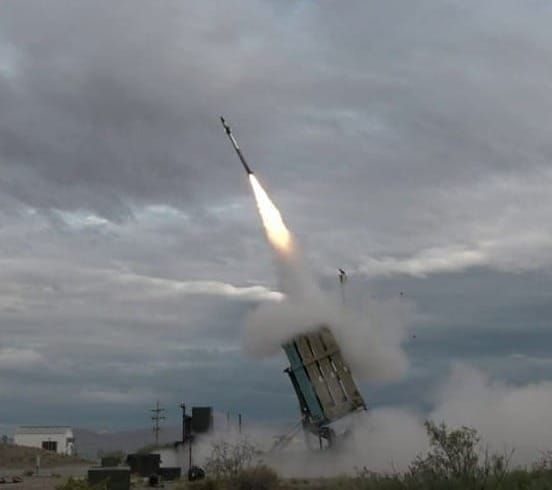
The US Marine Corps has moved an Iron Dome-derived air-defence system into the Western Pacific, closing a gap in its own Pacific war plan that had left forward Marines without medium-range protection for the first time in a generation.
The service announced late last month that III Marine Expeditionary Force, its only permanently forward-deployed MEF, had integrated the Medium-Range Intercept Capability, known as MRIC. Marines exercised the system on Guam during Valiant Shield 2026, the multinational drill that Admiral Samuel Paparo, head of US Indo-Pacific Command, toured as he reviewed allied deployments across the second island chain.
Lt. Gen. Roger Turner, who commands III MEF, said the step was meant to "send a clear message to the region."
The fielding answers a problem the Corps created for itself. The reason it needs the capability now runs through Force Design, the modernisation programme that reoriented the Marines from land wars towards a contested maritime fight with China. Under the concept, small Marine units disperse across the first island chain, operating sensors and anti-ship missile launchers to detect and blunt Chinese naval movements.
That posture places them, and the bases they rely on, inside the reach of Chinese cruise missiles and armed drones. III MEF is headquartered on Okinawa, within range of numerous mainland air bases and missile batteries.
Ground-based air defence had become the hole in that plan. The Corps divested its last medium-range surface-to-air system, the HAWK, in the late 1990s, and has leaned since on the shoulder-fired Stinger for short-range cover. The service now describes MRIC as its longest-reaching air defence since the Cold War, restoring a layer it surrendered more than two decades ago.
The Corps bought a proven system instead of building one from scratch. MRIC pairs two American components, the Ground/Air Task-Oriented Radar and the Common Aviation Command and Control System, with the battle-management software and Tamir interceptor of Israel's Iron Dome.
Rafael's system carries a combat record the maker puts at more than 10,000 intercepts, at a success rate above 90 per cent, a pedigree that let the Marines field it quickly under middle-tier acquisition rules.
Produced in a US variant called SkyHunter, the interceptor arms trailer-mounted launchers holding 20 rounds apiece, giving a weapon born to defend fixed Israeli towns the mobility that expeditionary operations demand. Israel's Missile Defense Organization and Rafael delivered the first interceptors to the Corps in April.
MRIC sits at the top of a layered scheme. Beneath it, the Marine Air Defense Integrated System and a lighter variant counter close-in drones and low-flying aircraft, while MRIC extends the reach against cruise missiles. It offers no defence against ballistic missiles, the threat for which the Corps still depends on Navy and Army systems.
The Department of War's fiscal 2027 budget request included $233.6 million for the programme, and the service plans to field three batteries, 48 launchers in all, by 2028. Each interceptor engages targets from roughly two to 43 miles away.
Two questions hang over the effort, and the fielding announcement addressed neither. The first is depth. Three batteries make a thin shield against the volume of fire the People's Liberation Army could mass against Okinawa and other forward sites. The cost-exchange sum cuts both ways.
Against a cruise missile, a SkyHunter costing around $100,000 is an economical trade. Against cheap attack drones, some costing a few thousand dollars apiece, the same round becomes a costly way to kill a target designed to drain it. Israel manages that dilemma by firing only at threats projected to cause damage, husbanding its stocks. Marines defending a forward airfield under a saturation raid may not have that margin.
The second question is supply. SkyHunter comes off a single new line at East Camden, Arkansas, the Raytheon-Rafael plant that opened in 2025 and also builds Tamir rounds for Israel. That line is planned to grow from about 325 SkyHunter missiles a year towards 1,000 to 2,000 Tamir-class interceptors annually, an output that looks modest beside the burn rates of recent missile wars.
Israel's campaigns against Iran and its allies since 2023 have drawn down air-defence stocks broadly, and US forces expended roughly a quarter of the American THAAD interceptor inventory during the 12-day war with Iran in mid-2025. Rafael's chairman, Yuval Steinitz, said in May that Israel faced no interceptor shortage. Even so, one production line now serves Israel's wartime replenishment and a fresh American requirement at the same time.
None of this undercuts the logic of the purchase. The Corps identified a real vulnerability and filled it with a system that works, faster than a bespoke programme would have allowed. But whether three batteries drawing on a shared interceptor line can hold up under Chinese mass remains to be seen.
Comments ()