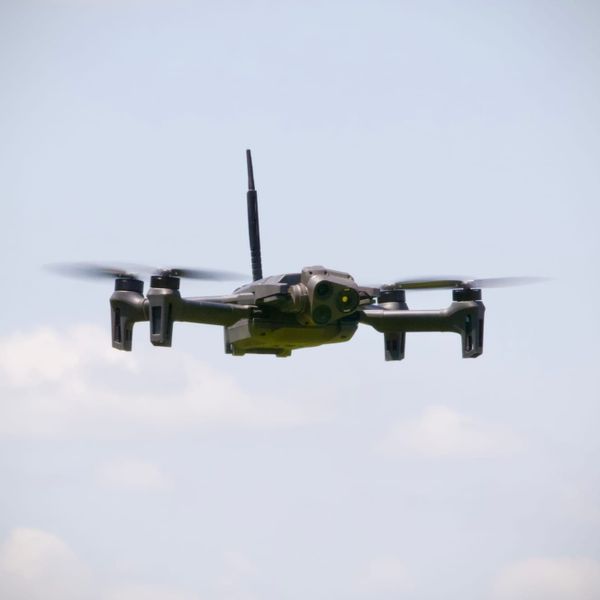
Germany is financing 50,000 Ukrainian attack drones equipped with US-designed guidance software built to track moving targets after their connection to a human operator is disrupted, in one of the largest disclosed Western drone orders for Kyiv.
The approximately €90 million programme combines Shrike first-person-view drones made by Ukrainian manufacturer SkyFall with Auterion Strike kits from US-headquartered defence technology company Auterion, according to Reuters. Deliveries have begun and are expected to be completed over the coming months.
The order reflects how Ukraine and its allies are adapting inexpensive attack drones to survive Russia's extensive electronic warfare defences. Conventional FPV aircraft are normally steered by an operator watching a live video feed, leaving them vulnerable if jamming breaks the radio or video link during their final approach.
Auterion's system uses computer vision to continue guiding a drone towards a designated moving target during the terminal stage of an attack. Once the target has been identified, the software can maintain its track even if communications with the operator are lost, reducing the opportunity for electronic warfare systems to defeat the aircraft before impact.
That does not necessarily mean the drones independently select whom or what to attack. The reported capability automates the final phase against a target already chosen by an operator, a distinction that has become increasingly important as militaries adopt weapons described broadly as autonomous or powered by artificial intelligence.
At €90 million for 50,000 aircraft, the programme averages approximately €1,800 per drone. That figure should not be treated as a confirmed unit price because the reported value may include guidance equipment and integration. It nevertheless illustrates the economics behind Ukraine's attempt to field precision attack systems at a scale conventional missiles cannot match.
A single guided artillery shell or anti-tank missile can cost tens of thousands of euros, while larger precision weapons may cost hundreds of thousands or millions. Cheap drones do not provide the same range or explosive payload, but their numbers allow Ukrainian units to strike vehicles and dug-in infantry without expending scarcer munitions.
The partnership also demonstrates an emerging division of labour in Western support for Ukraine. Ukrainian industry supplies an airframe refined through battlefield use, an American company provides the autonomy software and Germany finances production in quantities intended to affect operations across the front.
SkyFall's Shrike is already used by Ukrainian forces and is designed as an expendable strike platform. The addition of terminal guidance addresses one of the central weaknesses of remotely piloted FPV drones: their dependence on an uninterrupted signal in an environment saturated with Russian jammers.
Electronic warfare has become a continual contest of adaptation. Russia and Ukraine change frequencies and countermeasures as each side finds ways to disrupt the other's aircraft. Fibre-optic drones, which remain physically connected to their operators by thin cables, have emerged as one response to radio-frequency jamming. Autonomous terminal guidance offers another by allowing an aircraft to complete an attack after its wireless link has failed.
The technology is not a guarantee of success. Computer-vision systems can struggle in poor light or smoke, and can be fooled by camouflage or rapid movement. Their effectiveness also depends on the quality of onboard sensors and the point at which a target is acquired. Fielding 50,000 systems will provide evidence of whether autonomy developed in testing can perform reliably amid the disorder of the battlefield.
Germany has become one of Ukraine's largest military supporters, funding air-defence systems and ammunition while stopping short of deploying its own forces. Financing Ukrainian production allows Berlin to expand support without waiting for slower European procurement systems to deliver conventional equipment.
The order also points towards a broader change in military aid. Rather than transferring limited stocks of expensive Western weapons, governments are increasingly investing in Ukraine's ability to manufacture large numbers of systems designed around conditions at the front.
For Russia, the result could be thousands of additional attack drones that are harder to stop with jamming alone. For Ukraine's Western partners, the programme will test whether inexpensive autonomy can turn a disposable FPV aircraft into a more dependable precision weapon, and whether it can be produced quickly enough to matter.