
UK Places First Contracts in European Race for Cheap Drone Defences
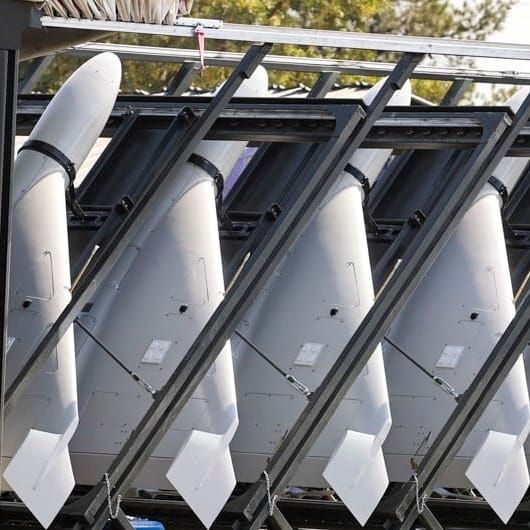
Britain has awarded £3.16 million ($4.2 million) to three companies developing low-cost weapons to intercept drones, becoming the first of five European partners to place national contracts under a joint air-defence initiative.
The relatively modest awards address one of the most pressing problems exposed by recent conflicts: inexpensive drones can be produced and launched faster than conventional air-defence missiles can be built or replenished.
Russia launched an average of 208 Shahed-type drones a day against Ukraine in March 2026. Such volumes are intended partly to exhaust defensive ammunition and force commanders to choose which threats warrant their most capable, and most expensive, weapons.
That creates an increasingly difficult economic contest. A Shahed-type one-way attack drone is generally estimated to cost tens of thousands of dollars, while some of the missiles capable of destroying it cost hundreds of thousands or even millions.
Although cheaper options such as guns, electronic warfare and interceptor drones are also used, the imbalance has placed mounting pressure on traditional air defences.
Britain’s Low-Cost Air Defence Effectors programme, known as LCADE, is intended to help close that gap. Its goal is to develop interceptors that can be manufactured quickly and in large numbers, preserving more sophisticated missiles for faster or more dangerous targets.
The Ministry of Defence selected Frankenberg Technologies, Greenjets and Cambridge Aerospace for the initial work. All three are small or medium-sized companies and will develop and trial their designs ahead of demonstrations expected later this year.
The awards are the British stage of Low-Cost Effectors and Autonomous Platforms, or LEAP, an initiative launched in February by the UK, France, Germany, Italy and Poland. Each country is initially holding its own competition. The partners then plan to identify systems suitable for joint procurement and large-scale production.
That later phase could prove more important than the first contracts themselves. Producing an affordable prototype is one challenge; building thousands of reliable interceptors across several countries, using resilient supply chains, is another.
The contracts were placed through Commercial X, a Ministry of Defence team intended to accelerate procurement and make defence competitions more accessible to smaller suppliers. The team has also supported contracting for hypersonic and directed-energy programmes.
Cambridge Aerospace was only recently identified by the department, which presented its selection as evidence that opening competitions to new entrants can uncover previously overlooked technology.
The company’s Skyhammer interceptor has attracted attention, although reported claims of a roughly 30-kilometre range and a £20,000-to-£40,000 price have not been confirmed by the Ministry of Defence.
National Armaments Director Rupert Pearce said the awards demonstrated what could be achieved by bringing agile British companies into defence procurement. Greenjets chief executive Anmol Manohar said the company looked forward to demonstration trials later this year.
The work forms part of a wider British push to counter drones with a layered mix of weapons. That effort includes DragonFire, a laser system due to enter Royal Navy service from 2027 and designed to engage aerial threats at a fraction of the cost of conventional missiles.
The £3.16 million awards will not by themselves solve the drone-defence problem. But they mark the opening move in a European attempt to change its economics: meeting mass-produced threats with interceptors that can also be produced at scale.
Comments ()