
What CARAT Thailand Reveals About Indo-Pacific Alliances: A Web of Diverging Interests
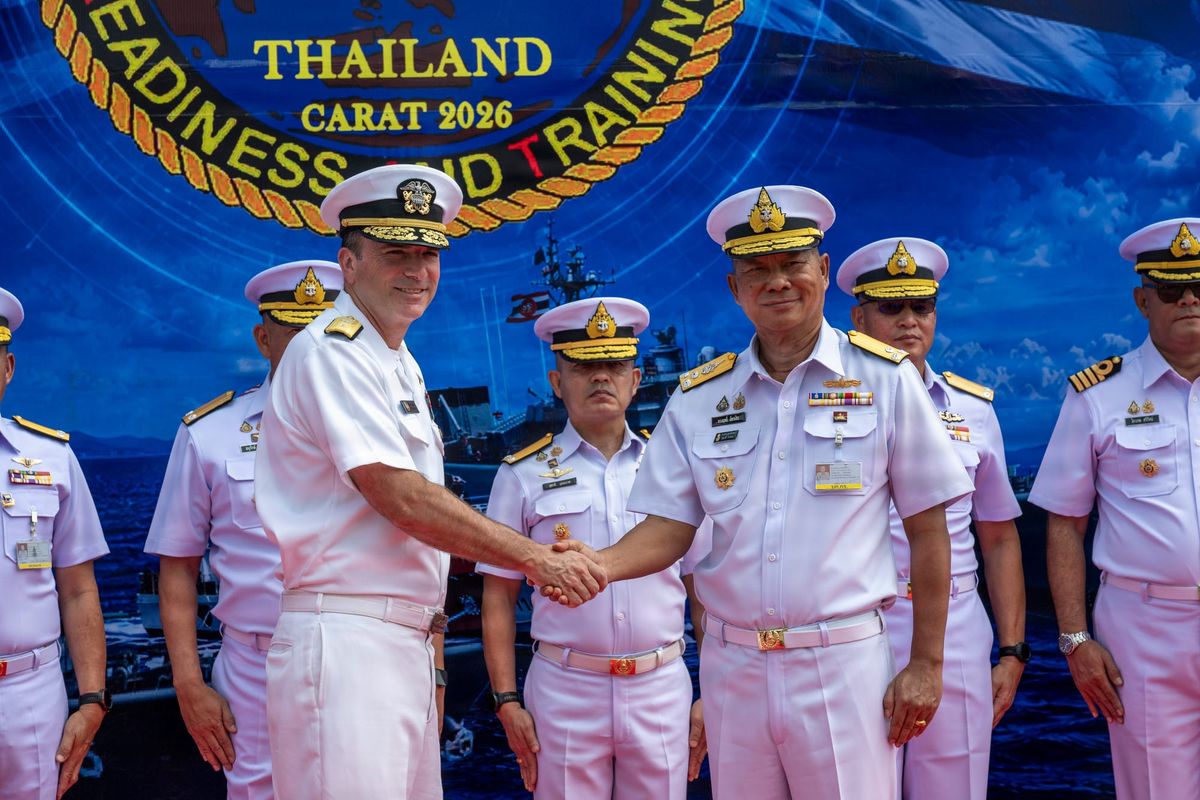
Thai and American forces opened the 32nd iteration of Cooperation Afloat Readiness and Training, known as CARAT, at Sattahip on 6 July. This year's version included two firsts: the debut of US Coast Guard fast response cutters in the exercise, and the integration of a Royal Canadian Navy boarding team alongside American and Thai sailors. The opening ceremony produced the expected images of allied unity, with a Thai admiral and an American admiral shaking hands at Laem Tian Pier.
Look past the handshake, though, and the two countries flanking Washington in this year's drills, Thailand and Canada, are heading in markedly different directions. One is a formal treaty ally that has spent a decade drifting toward Beijing. The other has no legal obligation to show up in the Indo-Pacific at all, yet keeps turning up anyway, even as its biggest defence cheque this year went to the opposite side of the map.
Thailand's slow drift
Thailand's alliance with Washington is, on paper, one of the oldest security relationships in Asia. The two countries signed a treaty of amity in 1833, and Thailand became one of only three Asian signatories to the 1954 Manila Pact. Bangkok was named a major non-NATO ally in 2003, and it has co-hosted the Cobra Gold exercise with the United States every year since 1982, an exercise Emma Chanlett-Avery, director of political-security affairs at the Asia Society Policy Institute, has described as the largest multilateral military exercise in the world.
Yet the substance behind those exercises has been thinning for years. After a 2014 military coup toppled Thailand's elected government, Washington pulled back sharply on arms sales, and Beijing stepped into the gap. According to the Lowy Institute, citing data from the Stockholm International Peace Research Institute, China sold Thailand $394 million in arms between 2016 and 2022, against $207 million from the United States over the same period, ranging from surface-to-air missiles to tanks and radar systems. Thailand is now also working with China on its first submarine.
Chanlett-Avery argues that Thailand's tilt is accelerating the erosion of American influence across South-East Asia more broadly. Zach Cooper, a senior fellow at the American Enterprise Institute, frames the risk in starker terms: he sees the two allies approaching a genuine decoupling, one that could mean fewer arms deals, thinner training programmes, and reduced access to bases including U-Tapao, the naval airfield Washington would most need in a Taiwan Strait contingency. The exercises continue, but the political ground underneath them keeps shifting toward Beijing.
Canada's costly courtship
Canada sits on the opposite side of this pattern. It carries no treaty obligation in South-East Asia, yet has spent the past four years working to establish a presence there anyway. Ottawa published its Indo-Pacific Strategy in November 2022, committing roughly $2.3 billion over five years, including close to $493 million earmarked specifically to expand Canada's naval presence and its participation in regional exercises.
That spending has translated into a packed schedule. HMCS Charlottetown had barely finished Exercise Valiant Shield, a ten-day, US-led drill across Guam, Hawaii and Japan that wrapped up on 1 July, before Canadian sailors joined CARAT Thailand days later. The same frigate sailed alone through the Taiwan Strait on 22-23 May, defying an earlier warning from China's ambassador to Canada that further transits would damage the countries' newly announced strategic partnership.
Beijing's Foreign Ministry issued a formal protest on 29 May, days before Chinese Foreign Minister Wang Yi's visit to Ottawa, the first such trip by a Chinese foreign minister in a decade. Vina Nadjibulla of the Asia Pacific Foundation of Canada called the transit a clear signal that Canada intends to chart its own course through the region, even while pursuing closer trade ties with China at the same time.
That signal, however, sits alongside a different kind of choice. On the same day CARAT Thailand opened, Prime Minister Mark Carney announced that Germany's ThyssenKrupp Marine Systems had been selected as preferred supplier for Canada's largest defence procurement in its history: up to 12 Type 212CD submarines to replace the ageing Victoria-class fleet, with a final contract still to be negotiated.
The winning design was sold heavily on Arctic endurance, NATO interoperability and its place on an existing German-Norwegian production line. Ottawa had at one stage considered splitting the order between Germany and South Korea's Hanwha Ocean, an arrangement that would have based some Korean-built boats on the Pacific coast for possible Indo-Pacific deployment; that option was dropped in favour of a single supplier. Submarines can be redeployed once they enter service, leaving room for an eventual Pacific role.
For now, though, the decision shows where Ottawa's most expensive defence dollars are going first: the Arctic, the Atlantic and NATO, ahead of the Indo-Pacific.
A patchwork, not a network
CARAT Thailand's opening ceremony offers a tidy image of a united front. The reality underneath it is closer to a patchwork of separate calculations. Thailand, bound by seven decades of treaty obligation, is hedging away from Washington as its economic centre of gravity shifts toward Beijing. Canada, with no such obligation, is edging toward the region diplomatically and militarily, even as its most consequential hardware decision still reflects older priorities: the Arctic, the Atlantic and NATO.
Exercises such as CARAT are a reliable measure of who wants to be photographed showing up. They are a far less reliable measure of whether the participants' underlying interests are actually converging.
Comments ()