
US Reveals Its Stealth Bomber Can Sink Ships in Warning to China
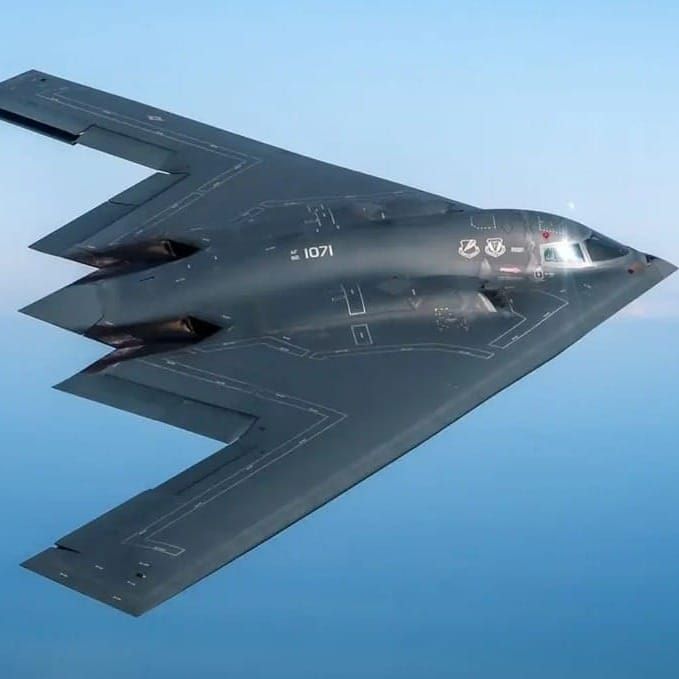
The US Air Force has disclosed for the first time that its B-2 Spirit stealth bomber can launch the Long-Range Anti-Ship Missile, revealing a penetrating maritime-strike capability designed to hold China's expanding navy at risk.
Pacific Air Forces announced on Monday, 29 June, that it had conducted a live-fire sinking exercise north of the Mariana Islands in which a B-2 fired the Lockheed Martin AGM-158C LRASM at a surface target. The drill formed part of Exercise Valiant Shield 2026, with the missile launched against the ex-USS Juneau, a decommissioned amphibious warfare ship.
"The B-2's impressive performance underscores the US military's commitment to adaptability and flexibility in the face of emerging security challenges," said General Kevin Schneider, commander of Pacific Air Forces. By prioritising counter-maritime strike, he said, US forces could maintain "a decisive edge over adversaries" and help secure a free and open Pacific.
The announcement carries weight because the B-2's ability to carry the LRASM had never previously been made public. Air Force Global Strike Command said details of the integration remained classified and declined to confirm whether the exercise marked a first for the aircraft. Until now, only the US Navy's F/A-18E/F Super Hornet and the Air Force's B-1B Lancer were publicly known to carry the weapon.
Pairing the survivable, hard-to-detect bomber with a stealthy anti-ship missile gives Washington a fresh way to threaten high-value vessels from well outside an adversary's defensive reach. The LRASM has a range of more than 370 kilometres and carries a 450-kilogram warhead. Its low-observable profile and in-flight data link are designed to help it slip past modern air defences. A single B-2 is thought capable of carrying up to 16 of the missiles, allowing one aircraft to engage several ships in a single pass.
That capability is aimed squarely at the People's Liberation Army Navy, now the world's largest by number of hulls. The PLA Navy fielded 103 principal surface combatants last year, up from 80 in 2020, with 83% of them classed as modern, according to the International Institute for Strategic Studies. Its third aircraft carrier, the Type-003 Fujian, has completed sea trials, and its surface fleet has surpassed half the US Navy's capacity in vertical-launch missile cells.
The growth of Chinese long-range air defences has sharpened the appeal of stand-off weapons. The PL-15 air-to-air missile, with a reach of about 200 kilometres, entered service in 2018, followed by the 400-kilometre PL-17 in 2024. Aircraft firing the LRASM can strike from beyond the worst of those engagement zones, improving the odds of survival for crews operating near contested waters.
Cost remains a constraint. Each LRASM is priced at upwards of $3 million, and the Air Force plans to buy 115 in the coming year and roughly 550 by the end of the decade. Analysts have warned that the service cannot procure the missile in the numbers a major conflict would demand, prompting interest in cheaper munitions such as the QUICKSINK guided bomb to broaden its maritime-strike options.
The disclosure forms part of a wider push to spread anti-ship firepower across the US air fleet. Work is under way to integrate the LRASM on the F-35 and the P-8A Poseidon maritime patrol aircraft, with the F-15 and F-16 also under consideration. The effort would build redundancy into American strike forces, allowing land-based bombers and fighters to take up the maritime mission should carrier-based aircraft be degraded in a Pacific conflict.
The B-2 has been unusually active in the region in recent weeks. The bomber took part in the Royal Australian Air Force's Exercise Diamond Storm earlier in June, operating from RAAF Base Amberley in Queensland. Nineteen of the aircraft remain in service as the Air Force awaits the arrival of its next-generation B-21 Raider.
For Washington, revealing the capability now serves a deterrent purpose of its own. Making clear that its most survivable bomber can sink ships at long range signals to Beijing that even a heavily defended carrier group could come under threat from an aircraft it would struggle to detect.
Comments ()