
Royal Navy Launches Combat-Proven Nyan Strike Drone From Warship for First Time
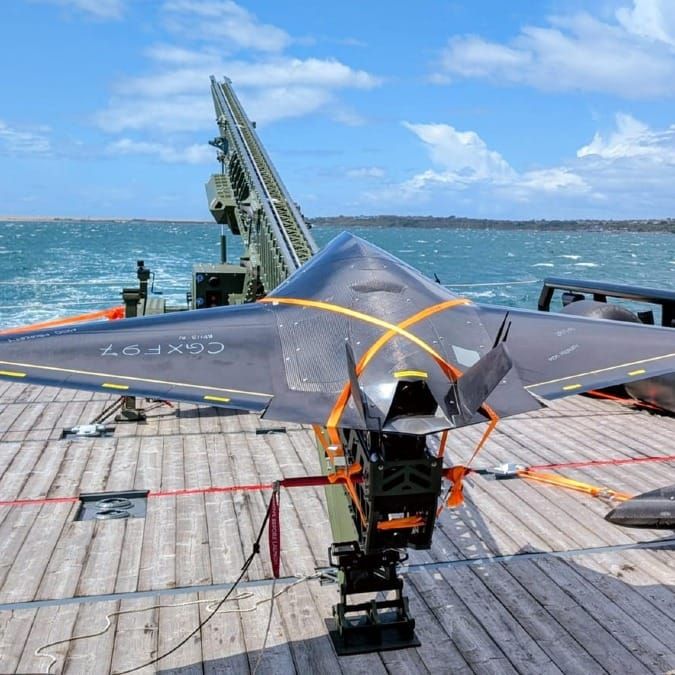
The Royal Navy and British Army have launched a domestically built strike drone from a warship at sea for the first time, a step towards a fleet that pairs crewed vessels with cheap uncrewed weapons.
The trial saw the Nyan One-Way Effector, a small attack drone made by BAE Systems subsidiary Callen-Lenz, launched from the experimentation ship XV Patrick Blackett off the south coast of England last month. It formed part of Exercise Neptune Reach under Project Vantage, a Royal Navy programme set up to speed the testing of maritime attack drones.
The Nyan has a 2.9-metre wingspan and is built for precision strike. Engineers fitted a launcher to the ship's deck capable of releasing the drone at up to 55 metres a second, a set-up meant to prove how the aircraft could be operated from a moving naval platform.
"Britain is serious about the transition to a Hybrid Navy with new, powerful drones at the heart of the Royal Navy," said Luke Pollard, Minister for Defence Readiness and Industry. He said bringing army and navy expertise together to fire strike drones from a ship at sea was accelerating the capabilities British forces need to stay ahead of adversaries.
Callen-Lenz has already produced more than 1,000 of the aircraft, and the type has seen combat abroad. Industry reporting has linked its operational debut to Ukraine, where cheap one-way drones now shape the battlefield and have destroyed armour and warships worth far more than the drones themselves.
"Nyan is already operationally proven on land, with more than 1,000 units produced. Now it has successfully demonstrated its ability to add real value in a maritime environment too," said Matt Foster, chief executive of Callen-Lenz.
In May, the British Army fired the Nyan during Exercise Spring Storm in Estonia, using it as part of British deep fire support for NATO. The drone is in service with 26 Regiment Royal Artillery, which has folded it into the army's long-range precision strike role.
Priced at under £100,000 a unit, the carbon-fibre aircraft has a range beyond 150 kilometres and is designed for production in bulk. The requirement that shaped it was set by the British Army in 2022, and the type entered service before its existence was made public in June.
Lieutenant Commander David Burton, the Royal Navy's capability sponsor for maritime one-way effectors, said the trial marked a significant step towards fielding such weapons at pace. He described plans to fold them into the Hybrid Navy alongside crewed ships, expanding the reach and tempo of the fleet.
The trial follows the government's decision on 29 June to cancel the Type 83 destroyer and reshape the Royal Navy around at least six Common Combat Vessels, hybrid warships built to command fleets of uncrewed systems. That announcement, made ahead of the full Defence Investment Plan, set up an effort called Atlantic Strike, aimed at turning experimental drone launches into deployable firepower for the fleet.
Burton pointed to the same programme when describing where the Nyan work is headed. Firing a weapon already proven on land from the deck of a ship points to a single cheap system that can be used across domains. That cuts the cost of holding targets at risk at sea, and fits a fleet being redesigned around distributed uncrewed mass in place of a small number of expensive warships.
The Royal Navy Capability team and the Air and Space Warfare Centre are now studying the results. Further trials could follow aboard the aircraft carrier HMS Queen Elizabeth.
The push reflects lessons drawn from Ukraine, where mass-produced uncrewed weapons have reset the economics of modern warfare. Britain's Strategic Defence Review of June 2025 called for a faster shift to uncrewed systems, and the navy has framed the Hybrid Navy as a way to add combat mass without the cost of building more warships.
The Nyan trials sit within FalconWorks, BAE's advanced research hub, which is developing uncrewed aircraft meant to fly alongside current and future frontline platforms. The company has said the aim is to deliver affordable combat mass, giving commanders more firepower for less money.
Callen-Lenz was bought by BAE's FalconWorks incubator in 2024. The firm built intelligence and surveillance drones before it turned to the one-way attack role, and it has said the Nyan design could be adapted for heavier payloads or longer range.
Comments ()