
Japan Puts Itself at the Centre of a New Indo-Pacific Order With India Pact
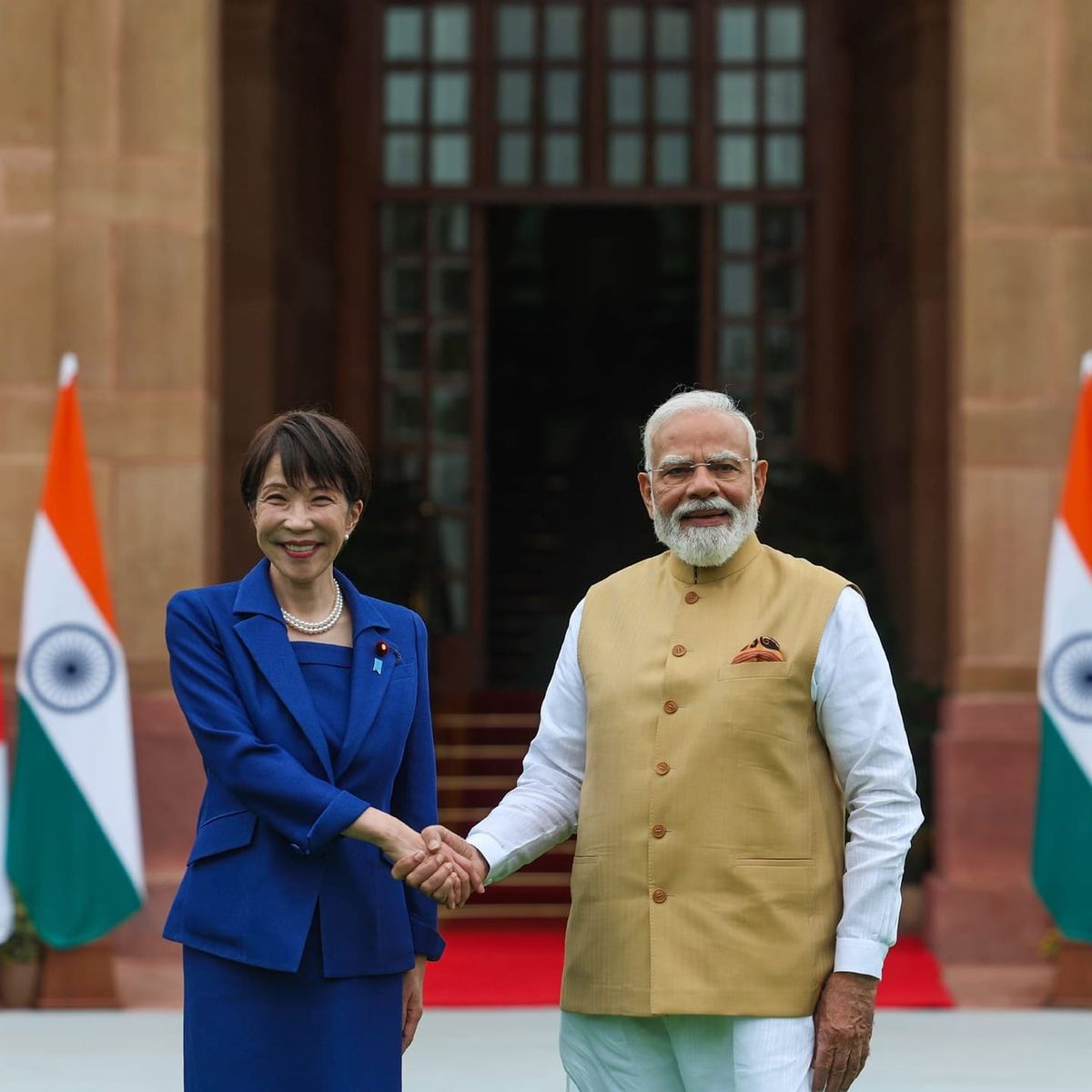
India and Japan closed their annual summit in New Delhi on Thursday with a run of agreements that pushed their partnership deeper into defence and energy than at any point in two decades of formal ties.
Prime Minister Narendra Modi and his Japanese counterpart Sanae Takaichi welcomed agreement in principle on what would become the first defence co-development project between the two countries. They also adopted a joint declaration on economic security and pointed to private-sector investment decisions worth around 2 trillion yen (US$12 billion), according to the summit's joint statement.
The meeting confirmed a shift that has been building for months. Japan is moving to place itself at the centre of a new security architecture in the Indo-Pacific, a web of partnerships that Tokyo is helping to design and equip.
That ambition rests on a change Tokyo made in April, when the cabinet scrapped rules that had confined its arms transfers to a handful of non-lethal categories. The revision cleared the way for Japan to sell finished weapons to the 17 countries that hold equipment and technology transfer agreements with it, India among them, according to the International Institute for Strategic Studies.
The India project followed the logic of that reform. The two sides reached agreement in principle on the remaining technical details of the Unified Complex Radio Antenna, or UNICORN, clearing the way for Bharat Electronics Limited to manufacture the system in India, according to the joint statement.
UNICORN is an integrated mast that houses a warship's antennas inside a single enclosed structure to cut its radar signature, and it already equips the Mogami-class frigates of Japan's Maritime Self-Defence Force. Modi called the agreement the start of a "new chapter" in defence technology cooperation.
The defence relationship is thickening in other ways. The two governments directed their foreign and defence ministers to hold a "two-plus-two" meeting in Tokyo before the end of the year, and they pointed to a widening set of drills that now reaches beyond the navies into land and air exercises, according to the joint statement.
UNICORN is one strand of a wider pattern. Japan agreed earlier this year to supply Australia with 11 upgraded Mogami frigates in a deal worth about US$10 billion, with most of the hulls to be built in Australian yards, according to the Observer Research Foundation. Tokyo is separately pursuing the transfer of Abukuma-class destroyer escorts to the Philippines, one of the first major tests of the new export rules. Takaichi has spent her first months in office tracing the outline of this network, reaching Washington in March and Australia in April before the New Delhi summit.
The summit also knitted together the two capitals' competing labels for the same idea. Takaichi presented an updated Free and Open Indo-Pacific built around resilience and self-reliance, and Modi set his own Great Ocean initiative alongside it, according to the joint statement. The labels matter little next to the alignment they signal across the Western Pacific and the Indian Ocean, the two theatres Japan is trying to bind into a single strategic space.
For India, the summit answered a more immediate problem. The decision by President Trump to go to war with Iran shut the Strait of Hormuz earlier this year, choking off a large share of the oil and gas that Asia draws from the Middle East. India holds only a few days of liquefied petroleum gas in reserve, and cooking-fuel shortages spread after the disruption, according to Indian industry data reported by Reuters.
That shock pushed energy security to the centre of the talks. The two governments agreed to cooperate on strategic petroleum reserves and to explore joint investment across the maritime energy transport chain, according to the joint statement. Both measures are hedges against the next disruption to the sea lanes on which India depends.
China ran through the summit as the other organising concern. Beijing has spent recent months punishing Tokyo over Takaichi's warning that a Chinese attack on Taiwan could draw a Japanese military response, restricting rare earth exports and squeezing tourism, according to Japanese and regional accounts. India has its own running border dispute with China and watches Beijing's growing presence in the Indian Ocean with unease.
The economic security declaration spoke to those anxieties. It commits the two sides to building more resilient supply chains and to reducing dependence on any single supplier of critical minerals and semiconductors, and both leaders raised "grave concerns" over economic coercion, according to the joint statement. Both governments pointed to progress toward an existing target of lifting Japanese investment in India to 10 trillion yen over the decade, and they agreed a roadmap for cooperation on artificial intelligence.
Even so, the limits of the partnership are real. India guards its strategic autonomy closely and will not sign up to a formal alliance. It still buys much of its weaponry from Russia and leans on Russian energy. Its trade with China keeps deepening even as the two spar along their border. New Delhi will coordinate with Tokyo where interests align and hold back where they do not.
Japan faces constraints of its own. More than 100 firms have left defence production over the past two decades, thinning the supplier base Tokyo now needs to fill export orders, according to the International Institute for Strategic Studies. Chinese commentary has dismissed Takaichi's diplomacy as "small-circle" clique-building, and some voices in Tokyo question whether her approach can hold broad regional support.
But none of that undoes the direction of travel. From defence to energy, the New Delhi summit showed a region reorganising around a set of partnerships that Japan is doing more than anyone to knit together. Washington remains the ultimate guarantor of Indo-Pacific security, and its reliability under Trump is now the very thing driving allies to hedge. Into that gap has stepped Tokyo, turning its industrial base and its diplomacy into the connective tissue of a regional order it is increasingly helping to shape.
Comments ()