
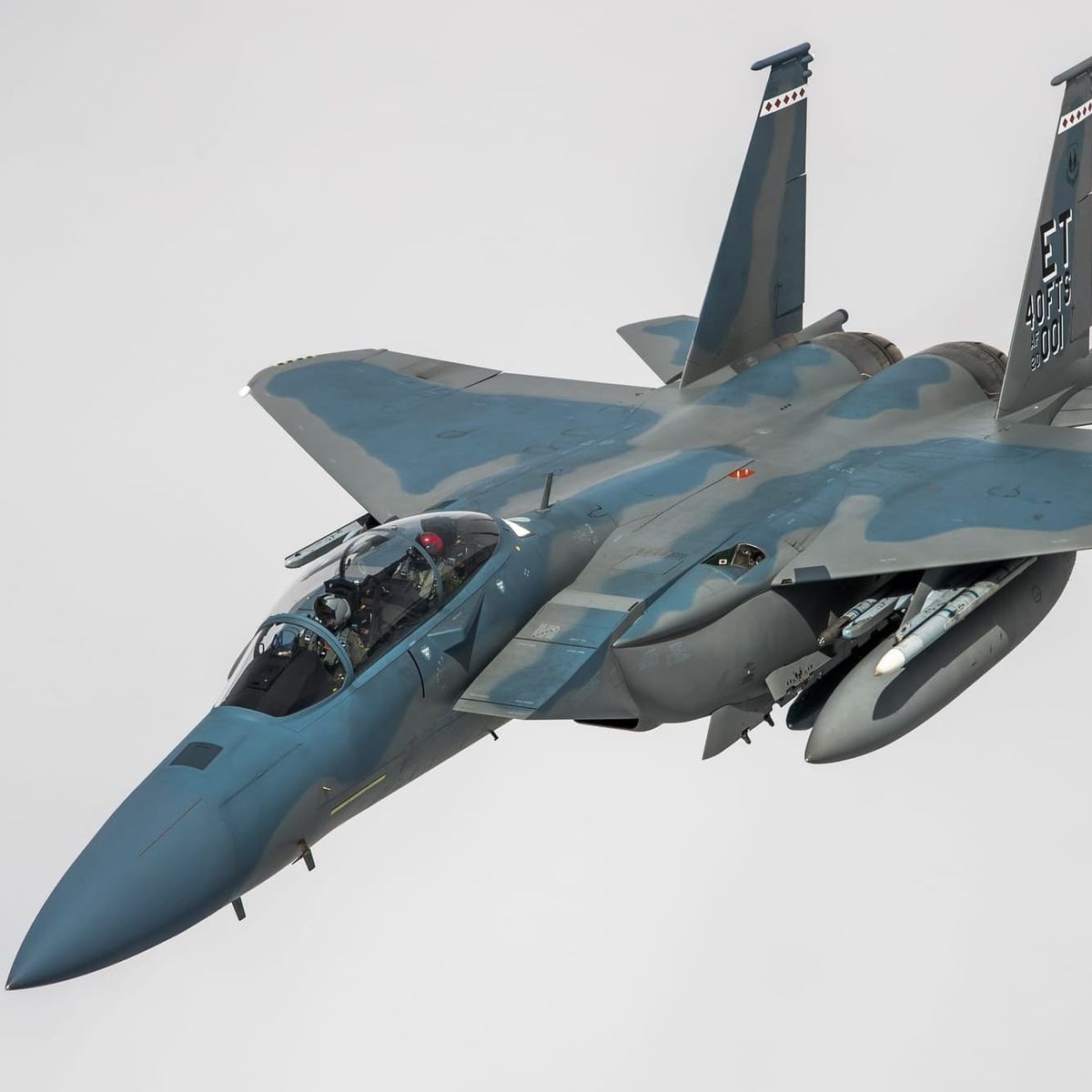
The US Air Force has begun rehearsing the return of permanent fighter power to Kadena Air Base, flying an F-15EX Eagle II into Okinawa on 29 June alongside two F-15E Strike Eagles.
Kadena, the closest major American air base to Taiwan, has spent nearly four years without a resident fighter squadron. The F-15EX is meant to end that gap. Thirty-six of the new Eagle IIs are due to replace the F-15C/Ds that guarded the base for more than four decades before their withdrawal began in late 2022.
For now the aircraft is only visiting. The Eagle II and the two Strike Eagles, from the 85th Test and Evaluation Squadron at Eglin Air Force Base in Florida, are there for familiarisation, giving the 18th Wing time to rehearse the maintenance and sustainment routines permanent operations will demand. Brigadier General John Gallemore, the 18th Wing commander, called the Eagle II "the next chapter of airpower at Kadena".
It's an indication of how important the F-15EX is to the future of US air power in Japan. The Pentagon announced in July 2024 that Kadena's ageing F-15C/D fleet would be replaced by 36 Eagle IIs. The first aircraft were initially expected in 2026, but production disruption at Boeing's St Louis plant has pushed that timetable into 2027, with the full complement unlikely before 2028.
Until then Kadena depends on rotating squadrons flown in from elsewhere, which keep aircraft on the ramp without restoring the resident combat mass the base once anchored.
The F-15EX is an unusual answer. It is not stealthy, and its design descends from a fighter first flown in the 1970s. What's really backing the Eagle II is its reach and payload, along with the staying power to keep flying sorties under a heavy weapons load.
The aircraft carries far more weapons than the F-15C/Ds it replaces. In an air-superiority configuration it can lift up to 12 air-to-air missiles. Its 23 hardpoints also take stand-off weapons such as JASSM cruise missiles and LRASM anti-ship missiles, and it is set to field the long-range AIM-260, built to outrange China's PL-15.
That turns the Eagle II into an arsenal aircraft. In the concept now taking shape across the Pacific, a stealthy F-35 pushes forward to locate targets and feeds the data back through the network. The F-15EX then uses its larger payload to fire from farther away, adding missile mass without forcing the smaller stealth fleet to carry every weapon itself.
That is the logic behind Kadena's new fighter. But it is also a source of risk.
Kadena sits roughly 400 miles from Taiwan and well inside China's growing missile range. In a conflict over the island, the base would almost certainly be among the first targets. Its runways and the aircraft parked on them lie within reach of the ballistic and cruise missiles China has fielded to suppress American airpower before it can launch.
A decade of wargames has warned that America's most important forward airfields are also among its most targetable. A 2024 Stimson Center study found that Chinese missile attacks could prevent fighter operations from US bases in Japan for roughly the first 12 days of a war.
The F-15EX does not lack combat power. The danger is that combat power concentrated on a single vulnerable runway can vanish in the opening salvo.
That is why the basing decision looks contradictory. The Air Force's own answer to the missile threat is Agile Combat Employment, which is designed to scatter aircraft across smaller airfields to deny China a dense, predictable target. Yet the US is now preparing to put a high-value F-15EX squadron back at the very hub Chinese planners have spent years learning to strike.
The tension runs deeper than the basing choice, because the US has largely declined to protect Kadena the obvious way. Its forward bases sit lightly sheltered, and senior commanders have been sceptical that hardening is worth the money: as head of Pacific Air Forces in 2023, General Kenneth Wilsbach questioned the value of building shelters at all.
The 2024 infrastructure plan said little about them, and few new shelters have gone up since. Guam still has none. The wager is on movement rather than hardening: if the aircraft at Kadena cannot be shielded in place, they must be able to leave quickly, and for somewhere useful.
But this contradiction eases if Kadena is read as a launch point rather than a fortress: a base that arms and turns around aircraft, then disperses them the moment conflict begins, the centre of a spoke network rather than a stationary garrison waiting to be hit.
That network is being built. In Wilsbach's phrase, the Air Force has "studied every single piece of concrete" across the Indo-Pacific for places to fly from, restoring old runways and securing fresh access: a 2023 agreement widened the US footprint in the Philippines, and in May 2025 Tinian North Field became a semi-permanent contingency site for aircraft displaced from Andersen.
The IISS counts around 45 exercises with an ACE component since 2020, across more than 35 airfields, and the tempo is rising: Resolute Pacific 2025 was the first run at scale, and this year's Bamboo Eagle put crews through operations in which they could not assume returning to the base they left.
Behind the airfields sits the harder problem of supply. Dispersed jets need fuel and munitions waiting where they land, and the Air Force has been pre-positioning both, pushing stocked kits out from key nodes to sustain short bursts of operations from austere strips; the 2024 Pacific Deterrence Initiative added USD917 million to that effort. Turnaround speed matters too: crews have leaned on hot-pit refuelling, with engines still running, and on forward points that pass fuel between aircraft without a fixed station.
The F-15EX suits this way of fighting: simpler to maintain than a stealth fighter, and worth as much for how fast it can be turned around as for what it can carry.
If the aircraft fits the concept, the concept itself carries two soft spots. The first is political. Dispersal assumes allies will let American combat aircraft fly from their soil, and that permission is not automatic. In a war over Taiwan, a partner might withhold its bases precisely to avoid being drawn in and struck, handing China a smaller target set.
The exercise record hints at how narrow the assured ground may be: between 2020 and early 2026, ACE drills used Japanese sites 14 times against just three, far less ambitious, outings in the Philippines. Japan is reckoned a reasonable bet for wartime access; much beyond it is not. The dispersal hedge may be thinnest in the waters closest to the fight it exists to deter.
The second soft spot is Chinese surveillance. ACE rests on the wager that scattered aircraft are hard to find and slow to hit, and China is working to erase that margin. The US Space Force assessed in late 2025 that the People's Liberation Army could call on more than 500 intelligence and reconnaissance satellites, part of an on-orbit expansion of over 1,100 spacecraft in a decade. A web of that density shortens the time between spotting a dispersed jet and striking it, pressing on the assumption that makes dispersal worth the effort.
The numbers matter too. The permanent force will be smaller than the one it replaces: 36 F-15EXs in place of 48 F-15C/Ds. Supporters call them far more capable than the old Eagles, but critics in Congress are less sure the arithmetic holds. Representative Rob Wittman, vice-chair of the House Armed Services Committee, backed the basing while pressing the Air Force for an "operational analysis" justifying the cut, warning of the message a smaller fleet sends to Beijing and Tokyo.
Ultimately, Washington is betting that Kadena can be both a hub and a target: powerful enough to generate combat mass, but connected and resilient enough not to be paralysed in the opening hours of a war. The F-15EX gives America more missiles near Taiwan. Whether they count will depend on the network waiting behind them; the spoke airfields, and the allied permission to use them.
Comments ()