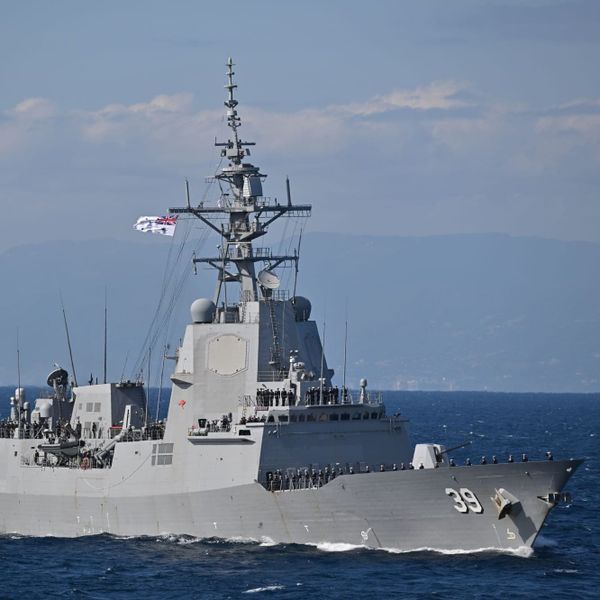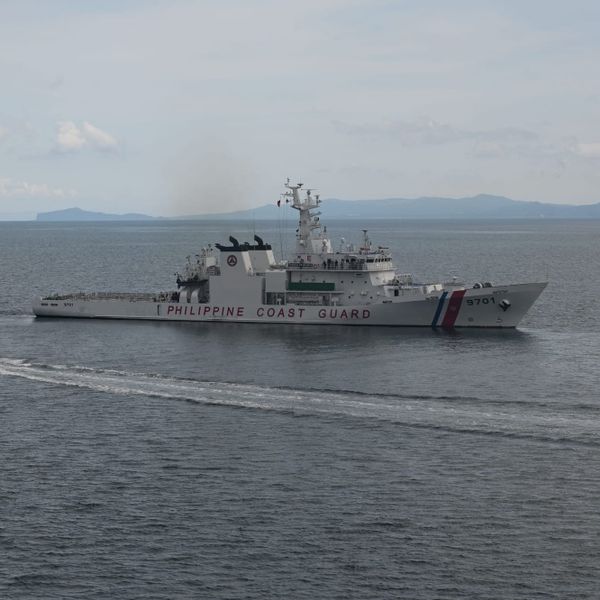
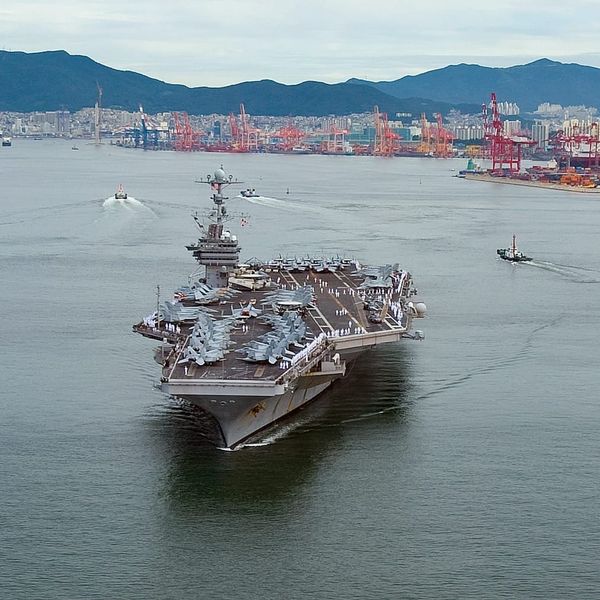
The arrival of the USS George Washington in Da Nang is the latest sign that Vietnam has acquired an important place in America’s strategy against China.
The US Navy’s forward-deployed aircraft carrier entered the Vietnamese port on 30 July accompanied by the cruiser USS Robert Smalls and the destroyer USS Shoup. More than 5,000 sailors arrived with the strike group, making this a highly visible demonstration of American naval power in a country that fought the United States within living memory.
It was the fourth visit by an American aircraft carrier to Vietnam since the war. The first came in 2018, followed by further visits in 2020 and 2023. The latest deployment also follows a visit by the USS Tripoli Amphibious Ready Group in December 2025 and a trip to Vietnam by Acting US Navy Secretary Hung Cao in June.
The timing is important. Washington’s 2026 National Defense Strategy calls for a “lasting and favourable balance of power” in the Pacific. Speaking at the Shangri-La Dialogue in May, US Secretary of War Pete Hegseth said America wanted a region in which no state, including China, could impose its hegemony.
That effort rests on a network of countries with very different relationships with Washington. Japan, South Korea, Australia and the Philippines are treaty allies. India participates in the Quad while preserving its strategic autonomy. Singapore offers access and logistical support although it is not a formal ally.
Vietnam may be the most difficult and strategically significant partner in this wider arrangement.
Its geography alone makes it strategically vital. Vietnam’s coastline runs for more than 3,000 kilometres along the western edge of the South China Sea. Hanoi claims the Paracel and Spratly Islands, putting it in direct competition with Beijing across waters that China claims almost in their entirety.
Vietnam is also developing the military infrastructure needed to defend those claims. The Asia Maritime Transparency Initiative estimates that Hanoi has now created approximately 2,771 acres of artificial land across its Spratly outposts. It has 15 harbours in the archipelago, 11 of them added since 2021, and is constructing specialised communications and aviation infrastructure.
These positions remain far less powerful than China’s heavily militarised island bases. Their rapid expansion nevertheless changes the operating environment. They should allow Vietnamese naval and law enforcement forces to remain at sea in greater numbers and for longer periods, making it harder for Beijing to establish uncontested control.
That serves American interests even if Vietnam never joins an American-led coalition. A more capable Vietnam forces China to contend with another determined maritime claimant along the South China Sea’s western flank. It disperses Beijing’s attention and raises the cost of using coastguard vessels, maritime militia and other forms of pressure to enforce its claims.
Washington has therefore concentrated on helping Vietnam improve its own maritime capabilities. Since lifting its arms embargo in 2016, the United States has supplied the Vietnamese Coast Guard with 24 Metal Shark patrol boats and three former Hamilton-class cutters. Vietnam has also ordered six ScanEagle surveillance drones and received 12 T-6C Texan II training aircraft in 2025.
The two countries established a Comprehensive Strategic Partnership in 2023, creating room for further cooperation in maritime security, defence technology and military training. Carrier visits reinforce that relationship by normalising the presence of high-end American naval forces in Vietnamese ports.
Hanoi has placed firm limits on how far this can proceed. Vietnam’s “Four No’s” defence policy rejects military alliances, siding with one country against another, foreign military bases and the use or threat of force in international relations.
Vietnam has held few substantial exercises with American forces, and current cooperation remains concentrated in areas such as coastguard capacity, maritime awareness, peacekeeping, military medicine and disaster relief.
There is no basis for assuming that Vietnam would support American military operations during a war over Taiwan or grant US forces access to its territory. Hanoi remains economically intertwined with China and continues to value its political relationship with Beijing. Its armed forces also retain large quantities of Russian equipment, limiting how quickly they can adopt American systems.
Vietnamese policy contains some flexibility. The 2019 defence white paper states that Vietnam may develop “necessary and appropriate” military relationships depending on the circumstances. This leaves Hanoi room to deepen security cooperation if pressure from China intensifies, while avoiding commitments that would compromise its independence.
For Washington, that ambiguity is manageable. America does not need Vietnam to become another Philippines. Its immediate value lies in its ability and willingness to resist Chinese domination on its own terms.
Trying to force Hanoi into an explicitly anti-China bloc would probably weaken the relationship. It would validate Beijing’s warnings about foreign encirclement and place Vietnam in the position it has spent decades avoiding: choosing between two much larger powers.
The George Washington’s presence in Da Nang therefore reveals both the opportunity and the limits of US strategy. America can help Vietnam become a stronger maritime power, expand defence ties and demonstrate that Hanoi is not isolated when China applies pressure. Vietnam will continue deciding for itself how that strength is used.
That still makes the country central to the regional balance. America’s position in Asia depends on more than the combat power of its formal allies. It also benefits from independent states capable of denying China an uncontested sphere of influence. Few are better placed to do that than Vietnam.