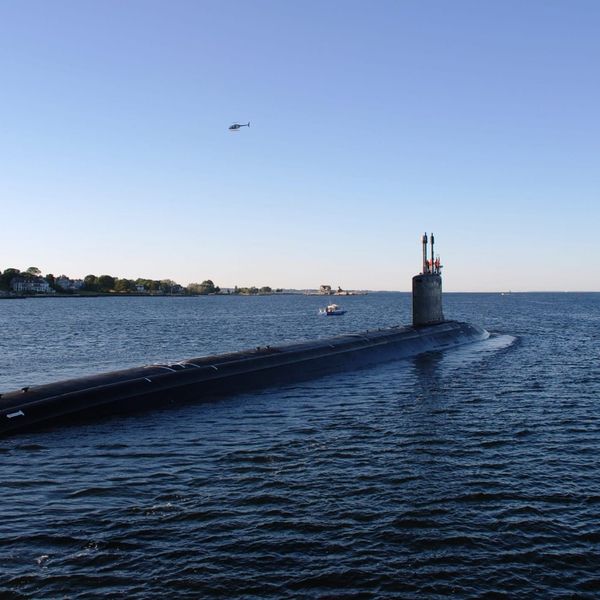
The US Navy is now classifying 19 planned Virginia-class submarines as guided-missile submarines, although nothing about their design has changed.
Announced on 3 August, the new designation applies to boats equipped with the Virginia Payload Module.
Until now, they had been classified as nuclear-powered attack submarines, carrying the SSN designation used by the rest of the Virginia class.
At first sight, the distinction may appear bureaucratic. The submarines were already scheduled to receive the payload modules. The announcement adds no hulls, missile tubes or weapons to the Navy’s existing plans.
Its timing, however, offers some insight into how the Navy sees the future of undersea strike.
The United States is beginning to retire its four Ohio-class SSGNs, which were converted from ballistic-missile submarines during the 2000s. USS Georgia is already entering the inactivation process, with the remaining three boats expected to leave service by the end of the decade.
These submarines are among the most heavily armed vessels ever built. Each can carry as many as 154 Tomahawk cruise missiles, giving the four-boat fleet a theoretical maximum of 616 vertically launched missiles. They can also carry special forces, deploy undersea vehicles and function as clandestine command centres.
The new designation formally presents the enlarged Virginias as their successors.
An ordinary Virginia-class submarine has two large bow tubes capable of carrying a combined 12 Tomahawks.
The Virginia Payload Module inserts an additional 84-foot section into the hull, containing four more large tubes. Each can accommodate seven Tomahawks, increasing the submarine’s vertical missile capacity from 12 to 40.
The module can also carry other large weapons and undersea payloads, giving the Navy room to introduce capabilities that may not yet have been publicly identified.
These submarines will retain the sensors, torpedo tubes and stealth characteristics required for anti-submarine warfare, intelligence collection, attacks against surface ships and special operations.
That makes the distinction between SSN and SSGN less clear than it was with the Ohio class. The new boats will remain multi-purpose Virginia-class submarines. Their designation will emphasise the additional missile capacity they carry.
According to the Navy’s announcement, the first of these boats, SSGN 803, is expected to be delivered in the 2029 financial year. Deliveries of all 19 are scheduled to continue through 2038.
The missile arithmetic presents a complicated picture.
Nineteen Virginia SSGNs could theoretically carry 760 vertically launched Tomahawks between them, exceeding the 616 carried by four Ohio SSGNs.
However, 228 of those positions come from the 12 bow-launched missiles that the submarines would have carried without the new module. The VPM sections themselves add 532 positions.
The Congressional Research Service has previously calculated that 22 VPM-equipped Virginias would be required to reproduce all 616 missile positions lost with the Ohio SSGNs on this like-for-like basis.
Neither calculation provides a complete measure of combat power. Submarines do not necessarily deploy with their theoretical maximum Tomahawk load, and some VPM tubes may carry different weapons or undersea systems.
More importantly, installed capacity is not the same as missile capacity available in an operational theatre.
The Ohio SSGNs use alternating Blue and Gold crews inherited from their original ballistic-missile role. One crew can rest and train ashore while the other operates the submarine, allowing the hull to remain forward for exceptionally long deployments.
USS Michigan, for example, spent 20 months deployed in the Western Pacific during 2013–15, with its crews swapping five times. The Navy says this dual-crew system maximises the strategic availability of each Ohio SSGN.
Virginia-class attack submarines have traditionally operated with a single crew. The Navy has not said whether the 19 reclassified boats will adopt Blue and Gold crewing or retain the existing Virginia model.
This does not necessarily mean they will provide less operational availability. The Navy will eventually have many more Virginia SSGNs than it had Ohio SSGNs, distributing its strike capacity across a larger number of submarines. Yet without knowing the crewing and deployment model, it is difficult to compare the two fleets using missile tubes alone.
The new designation also raises questions about how commanders will employ the boats.
Attack submarines are particularly valuable in a conflict with a sophisticated naval power. Their missions include hunting hostile submarines, tracking surface warships and gathering intelligence inside heavily defended waters. These demands are growing as the United States refocuses on competition with China and Russia.
A Virginia assigned to remain within range of land targets may be less available for other missions. At the same time, submarine operations rarely fall into such neat categories.
A boat positioned for missile strikes may also collect intelligence or monitor adversary naval movements. The Navy’s announcement does not establish that the designation will narrow their operational role.
Another unresolved question concerns force structure. The Navy’s stated objective calls for 66 attack submarines. At the beginning of the 2026 financial year, it had 49.
It is unclear whether the new Virginia SSGNs will continue to count towards that attack-submarine requirement. Excluding 19 planned boats from the SSN total would substantially change how the future shortfall is measured.
Including them would acknowledge that the operational distinction between the two categories remains limited.
There may also be a congressional dimension. Describing these submarines as the direct successors to the Ohio SSGNs could strengthen the Navy’s argument for protecting Virginia procurement and industrial funding.
Congress would be considering reductions to a named undersea strike replacement rather than an optional enhancement to an attack submarine.
For now, this remains an inference. The Navy has not connected the redesignation to appropriations, and Virginia-class construction already enjoys substantial support in Congress.
Days before the announcement, the Navy awarded a $76.6 billion package covering nine Block VI Virginias, material for a tenth and five Columbia-class ballistic-missile submarines.
The cautious reading is that the decision formalises a real strategic transition using submarines that were already planned. The Navy is moving from four enormous, dual-crewed missile carriers towards a more dispersed fleet of smaller, multi-role boats.
There is a clear logic to distributing conventional strike capacity across more submarines. The practical result will depend upon production rates, crew arrangements, missile loadouts and how commanders balance strike missions against the growing demand for submarine hunting and intelligence collection.
The SSGN designation tells us how the Navy wants these submarines understood. Several important decisions governing their actual combat value have yet to be explained.