
US cutter monitors three Chinese research vessels during 112-day Arctic patrol
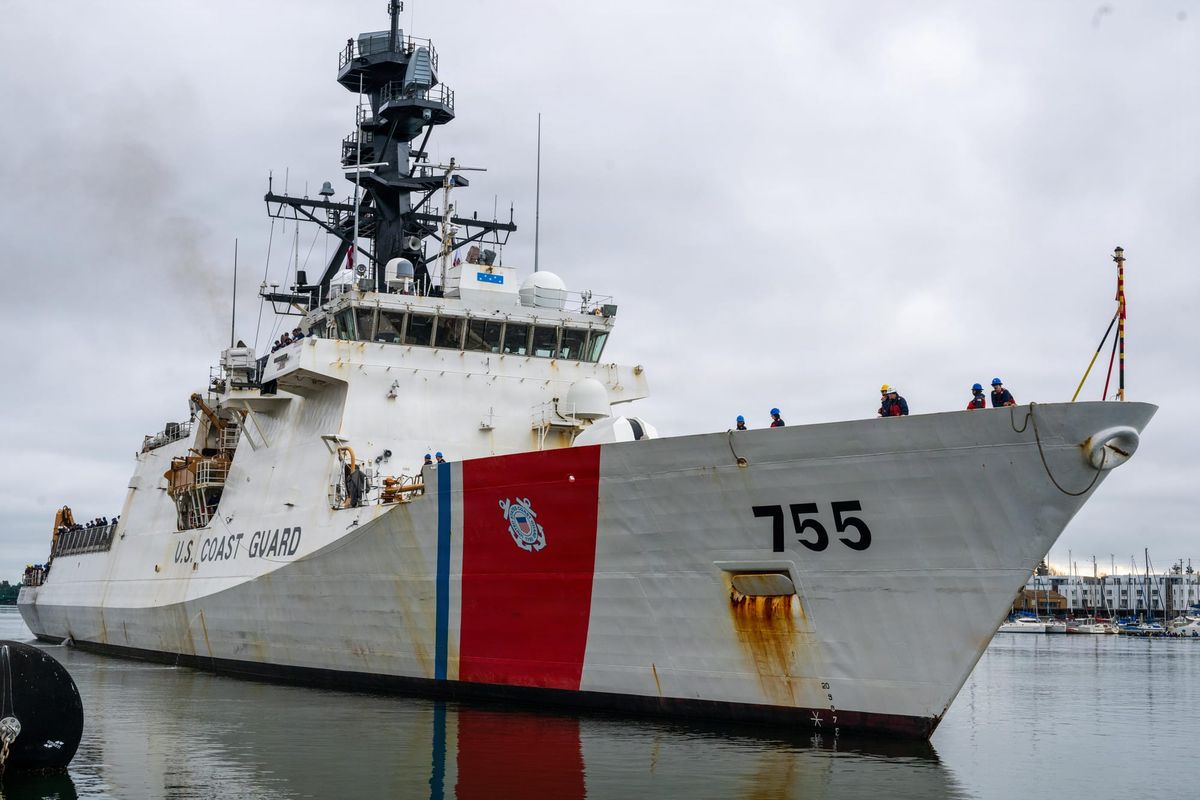
The US Coast Guard cutter Munro monitored three Chinese-flagged research vessels during a 112-day patrol around Alaska, extending Washington's surveillance of foreign activity near its Arctic maritime boundaries.
The national security cutter returned to Base Alameda, California, on 9 October after travelling more than 23,000 nautical miles across the Bering Sea and Arctic Ocean, the Coast Guard announced on 21 October.
Under Operation Frontier Sentinel, Munro monitored the Chinese vessels operating in and around what the service described as the US Arctic maritime domain.
The Coast Guard said the crew monitored compliance with international maritime law while protecting American sovereign interests. It did not identify the three vessels, disclose their precise locations or report any violations.
Munro also conducted exercises with the Royal Canadian Navy and participated in Operation Tundra Merlin, which brought together US and Canadian forces to test northern defence communications and command networks.
In July, the cutter sailed in formation with the Coast Guard icebreaker Storis and buoy tender Fir in the high Arctic.
Captain Adam Disque, Munro's commanding officer, said the deployment demonstrated the importance of maintaining an American presence in the region.
"We were proud to sustain U.S. presence in the region to safeguard our Arctic coastline and reinforce a rules-based order in the High North," Disque said.
Chinese research vessels return to Arctic waters
The latest patrol follows repeated encounters between US Coast Guard assets and Chinese research vessels operating near Alaska.
In July, the Coast Guard said Munro had monitored the research ship Xue Long as it travelled north through the US exclusive economic zone and across waters above the American extended continental shelf in the Bering Sea.
The service also reported that Xue Long 2, another Chinese research vessel, was heading towards the Arctic.
It was the first time in 2026 that the Coast Guard had tracked Chinese vessels travelling through those areas.
Similar activity occurred during 2025. In July that year, an American Coast Guard aircraft contacted Xue Long 2 approximately 290 nautical miles north of Utqiagvik, Alaska.
By August, the service was monitoring five Chinese research vessels operating in or near the US Arctic, describing their presence as consistent with a three-year trend of increased activity.
Maritime rights and scientific research
The expanding Chinese presence has drawn attention to the distinction between lawful navigation and marine scientific research in waters where the United States exercises maritime rights.
Foreign vessels may transit the US exclusive economic zone and waters above its extended continental shelf in accordance with international law.
However, coastal states generally have jurisdiction over marine scientific research conducted in their exclusive economic zones and on their continental shelves, subject to applicable international law.
The Coast Guard said in July that scientific research in these areas would require advance US permission and subsequent sharing of information collected.
Those requirements do not mean that foreign research vessels need permission simply to navigate the waters above the continental shelf.
The United States has not ratified the United Nations Convention on the Law of the Sea, although it recognises important provisions concerning maritime rights as customary international law.
The Coast Guard has not publicly established that any of the three vessels monitored during Munro's latest patrol conducted research without authorisation.
China expands its Arctic presence
China's 2018 Arctic policy describes the country as a Near-Arctic State and identifies scientific research, shipping, resource development and international cooperation as priorities.
Beijing maintains that non-Arctic countries have legitimate rights to conduct activities in the region under international law.
Washington nevertheless regards China's expanding polar capabilities as a strategic concern.
The Pentagon's 2024 Arctic strategy assessed that Chinese icebreakers support research with both civilian and military applications, including the testing of unmanned underwater vehicles.
Such capabilities could provide knowledge of underwater conditions relevant to navigation, submarine operations and other military activities, although their use does not by itself establish a military mission.
For the United States, the sustained presence of Chinese research ships creates an enduring monitoring requirement across an enormous and difficult maritime environment.
Munro's patrol illustrates how the Coast Guard is combining maritime surveillance, allied exercises and extended deployments to maintain that presence as Chinese activity in the Arctic continues.

Comments ()