Saronic Technologies plans to build a $3.2 billion shipyard at the Port of Brownsville, promising to produce autonomous vessels at a scale rarely attempted by an American defence start-up.
If it succeeds, Port Alpha could give the US Navy a new source of ships outside the small group of yards struggling to deliver its existing fleet.
The limits are equally clear. Port Alpha cannot directly address the delays affecting submarine and destroyer programmes or overcome unstable designs and shortages of skilled workers.
Its contribution will depend on whether Saronic can turn rapid progress with small autonomous boats into reliable production of much larger vessels.
Saronic announced the site selection alongside Texas Governor Greg Abbott on 16 July. Construction is expected to begin this year, with operations scheduled for 2028.
The initial site covers 835 acres, with room to expand to almost 4,400 acres. Saronic says the first build-out will be able to produce vessels up to 850 feet long, with later expansion supporting ships longer than 1,200 feet.
The company plans to create as many as 10,000 direct jobs over the next decade. That will require a maritime workforce on a scale Brownsville does not currently possess. Cameron County commissioners approved an incentive package estimated to be worth about $211 million across four phases in June.
It includes a 95% property-tax abatement, requires at least 35% of Saronic’s full-time workforce to be hired locally and reduces the benefit if the company misses its employment targets.
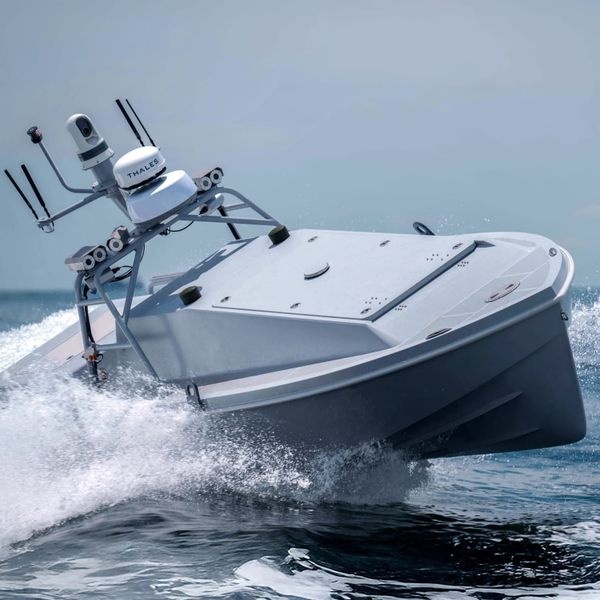
Saronic enters the project with more credibility than most companies proposing a new shipyard. The US Navy awarded it a $392 million production contract for Corsair, with nearly $200 million placed on contract at the outset.
Corsair is a 24-foot autonomous surface vessel with a range of more than 1,000 nautical miles.
Corsair moved beyond controlled demonstrations twice in five weeks. On 9 June, a Navy-operated vessel recovered two US Army crew members after their Apache helicopter came down off the coast of Oman, in what Saronic described as the first known rescue at sea by an autonomous boat.
On 12 July, three Corsairs were used in an attack targeting a submarine and ship-maintenance facility at Bandar Abbas naval base. US Central Command said it was the first American combat use of uncrewed surface vessels. The effectiveness of the strike has not been publicly assessed.
The larger test is Marauder, Saronic’s 180-foot medium uncrewed surface vessel. The first hull was designed and launched in less than a year, with three more under construction at the company’s Franklin, Louisiana, yard.
The Navy has selected Marauder as one of seven designs advancing to at-sea testing under its Medium Unmanned Surface Vessel Marketplace. Companies whose vessels successfully complete the tests will receive $15 million and become eligible for follow-on production.
Testing is expected to conclude by October, and eligibility still falls well short of a production order.
Saronic is investing $300 million to expand the Louisiana facility, which it says will be capable of producing 20 Marauders a year. Port Alpha would take that manufacturing model much further, combining large-scale ship construction with software-defined systems.
That approach aligns with the Navy’s plans for a more distributed fleet. Uncrewed vessels could carry sensors, communications equipment and other payloads across the vast distances of the Pacific.
They could remain at sea without large crews and absorb risks that commanders would hesitate to impose on a crewed warship.
Port Alpha could also create a separate production base. America’s established naval yards are already occupied with nuclear submarines, aircraft carriers and large surface combatants.
Directing autonomous and commercial-derived designs to a new yard would allow specialised builders to concentrate on the complex warships that cannot easily be produced elsewhere.
The need for additional capacity is substantial. Under the Navy’s 2025 shipbuilding plan, the fleet was projected to fall from 295 battle-force ships to 283 in 2027 before beginning a long climb towards 390 by 2054.
The Congressional Budget Office estimated that implementing the plan would cost about $40 billion annually in 2024 dollars, 46% more in real terms than the average amount appropriated over the preceding five years.
Money alone has not produced ships on time. The Government Accountability Office says American naval programmes have accumulated billions of dollars in additional costs and delays lasting years.
Workforce shortages have slowed construction, while immature designs and changing requirements have forced yards to redo work after production has begun. The Constellation-class frigate is the sharpest recent example, with the Navy stepping away from the programme in 2025 after exercising contract options worth more than $3 billion.
Port Alpha remains exposed to several of those problems. Its ability to accommodate an 850-foot hull says little about whether it can integrate weapons and survivability systems. Those requirements make frontline warships far more difficult to produce than commercial vessels or autonomous boats.
The yard will also require a supplier network and experienced naval architects. Software and automation cannot immediately create thousands of welders and machinists. Saronic will need to build that workforce while competing with other large industrial employers along the Texas Gulf Coast.
The largest uncertainty is demand. Saronic has not announced which vessels Port Alpha will produce or whether its later construction phases depend on future government orders.
A shipyard designed for mass production needs a stable pipeline of ships. The Navy has repeatedly described autonomous vessels as central to its future fleet while taking longer to settle their requirements and acquisition plans.
Port Alpha could still become an important part of America’s maritime recovery. Saronic closed a $1.75 billion funding round at the end of March, valuing the company at $9.25 billion.
It has also moved Corsair from prototype to production and operational use with unusual speed by naval procurement standards. That record gives the Brownsville project more substance than its rendering alone suggests.
The first meaningful measure of success will come after 2028, when the yard must begin delivering vessels reliably and at scale.
What the Navy needs from Brownsville is operational hulls arriving quickly enough to change the size and composition of the fleet, and Port Alpha will be judged on whether they arrive.