
Strait of Hormuz remains dangerous despite US claims of control
US Central Command has declared that American and regional forces control the Strait of Hormuz, even as a multinational maritime monitoring centre continues to warn that attacks on commercial shipping remain highly likely.
CENTCOM commander Admiral Brad Cooper visited the waterway on 25 October, saying its main transit routes remained clear of Iranian sea mines following US military clearance operations.
The command also said American forces had assisted Gulf partners in exporting more than 1.5 billion barrels of crude oil since the summer.
Yet a Joint Maritime Information Center (JMIC) advisory, updated with information to 25 October, retained a severe threat rating for the strait and reported hundreds of ships still waiting outside the waterway.
The two statements present different measures of the shipping situation: American military activity and assisted traffic on one hand, and the continuing risk faced by commercial vessels on the other.
US says it controls Strait of Hormuz shipping routes
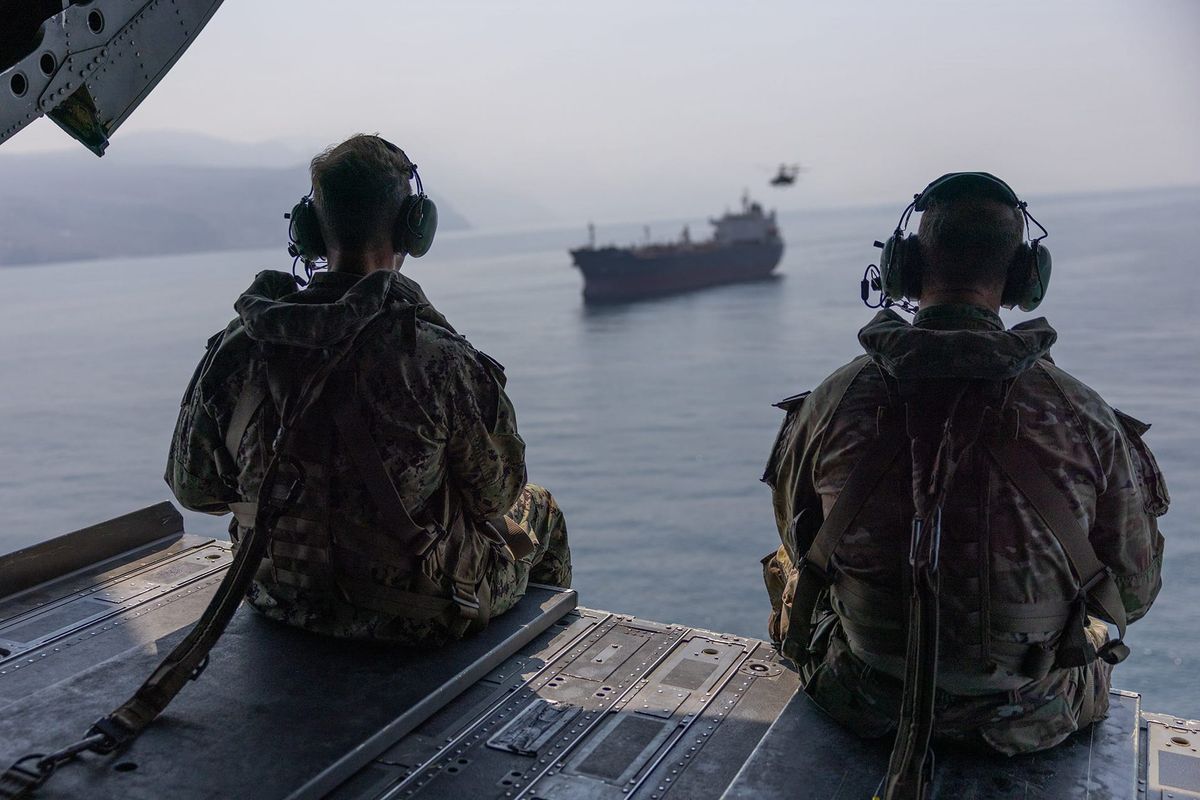
Cooper flew over the strait in a US Army CH-47 Chinook and met personnel involved in mine-clearance operations.
CENTCOM said more than 3,000 commercial vessels had transited with US military support during the preceding six months. It also claimed that more than 95 per cent of vessels navigating the strait had passed safely in recent months.
Those figures are CENTCOM's own assessments. Its announcement did not provide a detailed breakdown of the 1.5 billion barrels or explain the denominator used to calculate the safe-passage percentage.
Clearing mines from principal shipping lanes is also different from eliminating every threat to vessels using those lanes.
Severe threat rating remains
JMIC Update 108, with a reporting cut-off of 1300 UTC on 25 October, maintained its severe threat assessment for Hormuz.
The centre considered deliberate attacks highly likely and warned of continued monitoring, harassment and routing pressure associated with Iran's Islamic Revolutionary Guard Corps.
The latest report recorded 156 vessel incidents across its monitored period since 1 March.
It included an attack on an LPG tanker on 22 October, approximately seven nautical miles northeast of Limah, Oman, while the vessel was leaving the strait.
UK Maritime Trade Operations said the tanker had been struck by an unknown projectile. The vessel continued its voyage, and subsequent JMIC reporting indicated no casualties or environmental damage.
The incident demonstrates that the continuing threat is not confined to mines.
Shipping remains far below normal
JMIC estimated that about 492 vessels were waiting outside Hormuz on 25 October.
Its historical benchmark was approximately 138 vessel transits a day in 2025, compared with substantially reduced traffic under the current security conditions.
US naval shipping-coordination figures cited by JMIC recorded 101 US-facilitated transits between 22 and 24 October.
Separately, the centre's commercial tracking tables recorded only one to five non-facilitated cargo-vessel transits per day over the same recent period.
These datasets cover different vessel populations and cannot be added together or compared directly as a comprehensive count of all ships using the strait.
They nevertheless illustrate why CENTCOM's cumulative six-month traffic figure does not establish a return to normal commercial movement.
Control does not eliminate commercial risk
The distinction is consequential for shipowners, insurers and energy traders.
A military force may secure key routes, escort vessels and enforce a blockade while commercial operators continue to face the possibility of attacks, interference and delays.
JMIC also reported that the US blockade of Iranian ports remained in force, with neutral vessels permitted to transit but subject to possible inspection.
In Istanbul on 23 October, the foreign ministers of Türkiye, Egypt, Pakistan and Saudi Arabia called for the full restoration of safe and unrestricted navigation through Hormuz.
For now, CENTCOM's announcement indicates the scale of American efforts to keep the waterway functioning. The maritime advisory shows why shipping operators remain cautious.
The test of greater security will be sustained, independently observable traffic recovery alongside a reduction in attacks and the number of ships waiting to enter the strait.

Comments ()