
US proposes ASEAN defence framework as Singapore backs closer cooperation
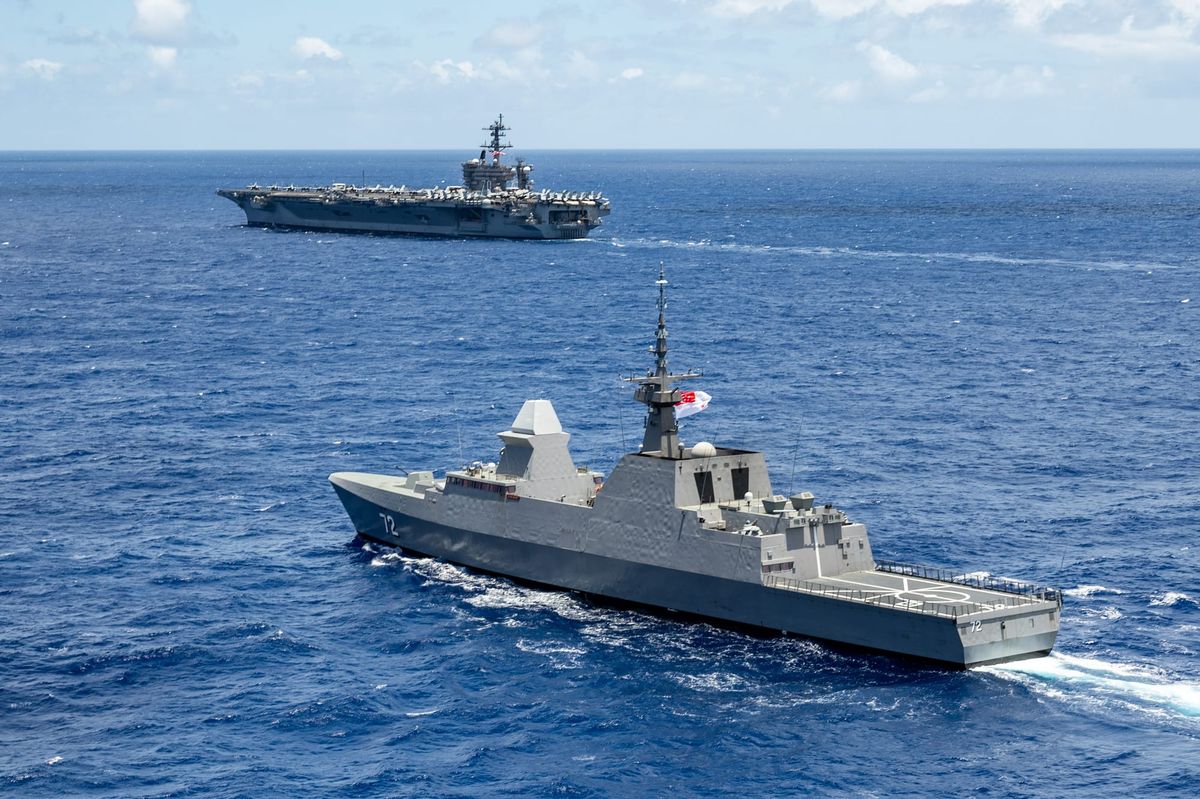
The United States has proposed a defence cooperation framework with Southeast Asia, with Singapore supporting its development as the country prepares to chair ASEAN's defence meetings in 2027.
US Secretary of War Pete Hegseth presented the proposal during the ASEAN–US Defence Ministers' Informal Meeting in Cebu, the Philippines, on 28 October.
He identified maritime domain awareness, military interoperability and cooperation among navies as priorities for closer engagement, proposing a framework to guide relations over the coming years.
Singapore's Defence Minister Chan Chun Sing subsequently confirmed his country's support for developing the proposal and facilitating American engagement with the Association of Southeast Asian Nations (ASEAN) during its 2027 chairmanship.
The development offers Washington a possible route towards more structured defence engagement with Southeast Asia. However, the available official statements do not establish that ASEAN's members have collectively approved the framework.
Nor has the United States announced specific funding, deployments or equipment commitments associated with it.
The question is whether Washington can translate a broadly acceptable diplomatic proposal into practical cooperation that offers something beyond existing regional security arrangements.
Washington emphasises practical defence cooperation
Hegseth described the American approach to regional security as sufficiently strong to deter aggression while avoiding unnecessary escalation.
He also acknowledged that countries need not agree on every issue to cooperate where their interests overlap.
The distinction matters in Southeast Asia, where governments maintain different defence relationships, strategic priorities and approaches to major-power competition.
The Philippines, for example, is a US treaty ally and has expanded military cooperation with Washington amid confrontations involving Chinese vessels in the South China Sea.
Other ASEAN members have different security arrangements and may be less willing to support initiatives perceived as directed against China.
By emphasising maritime surveillance, training and practical cooperation, Washington may be offering ASEAN members a form of defence engagement that does not require agreement on every regional security dispute.
That is a possible advantage of the proposal, rather than an objective explicitly established in the official statements.
Singapore offers support for the next stage
Singapore's position gives the proposal an identifiable diplomatic sponsor within ASEAN, although its support should not be confused with approval by the organisation as a whole.
In its account of the 28 October meeting, Singapore's Ministry of Defence said Chan welcomed continued American engagement and supported US efforts to develop an ASEAN–US defence cooperation framework.
Singapore also committed to facilitating that engagement when it chairs the ASEAN Defence Ministers' Meeting (ADMM) in 2027.
The timing coincides with the 50th anniversary of ASEAN–US dialogue relations.
On 29 October, Singapore formally received the ADMM chairmanship from the Philippines.
At the accompanying ADMM-Plus meeting, Chan argued for an inclusive approach to regional security cooperation, recognising that countries have different priorities and capabilities.
Maritime awareness provides a practical starting point
Maritime domain awareness could be one of the framework's most useful areas of cooperation.
Southeast Asian governments require reliable information about activity in their waters, including commercial shipping, illegal fishing, maritime incidents and foreign vessel movements.
Surveillance and information-sharing capabilities can support maritime law enforcement, search and rescue and national defence planning.
For countries involved in territorial disputes, they also have direct security relevance.
The Philippines has experienced repeated confrontations with Chinese vessels in disputed areas of the South China Sea.
An arbitral tribunal ruled in 2016 that China's claims to historic rights within the nine-dash line had no legal basis to the extent that they exceeded the maritime entitlements provided by the UN Convention on the Law of the Sea.
China rejects the ruling.
ASEAN members do not approach these disputes with identical priorities, making any regional defence initiative politically sensitive.
What would a new framework add?
ASEAN already has an established mechanism for practical defence cooperation with external partners.
The ADMM-Plus brings together the organisation's 11 members and eight dialogue partners, including the United States, Australia, China, India, Japan and Russia.
Its activities include specialist working groups, military exchanges and exercises covering shared security challenges.
Existing arrangements provide for cooperation in areas such as maritime security, humanitarian assistance, military medicine and cybersecurity.
A new US–ASEAN framework would therefore need to demonstrate additional value rather than duplicate established activities.
Possible contributions might include more consistent planning, enhanced maritime information-sharing, specialist training or access to surveillance capabilities.
Diplomatic proposal to military cooperation
The Cebu meetings have established a basis for further discussion, not a completed defence agreement.
Washington has proposed a framework. Singapore has supported its development. ASEAN's official account confirms that future defence cooperation was discussed at the informal ministerial meeting.
The next meaningful developments will be whether the participating governments agree on a process for taking the proposal forward, identify priority projects and commit resources.
For the United States, the test will be whether the framework offers practical benefits that Southeast Asian governments cannot already obtain through existing arrangements.
For ASEAN, the challenge will be accommodating those opportunities while maintaining the inclusiveness and diplomatic flexibility of its regional defence institutions.


Comments ()