
Finland deepens defence ties with Japan and Australia as security cooperation expands
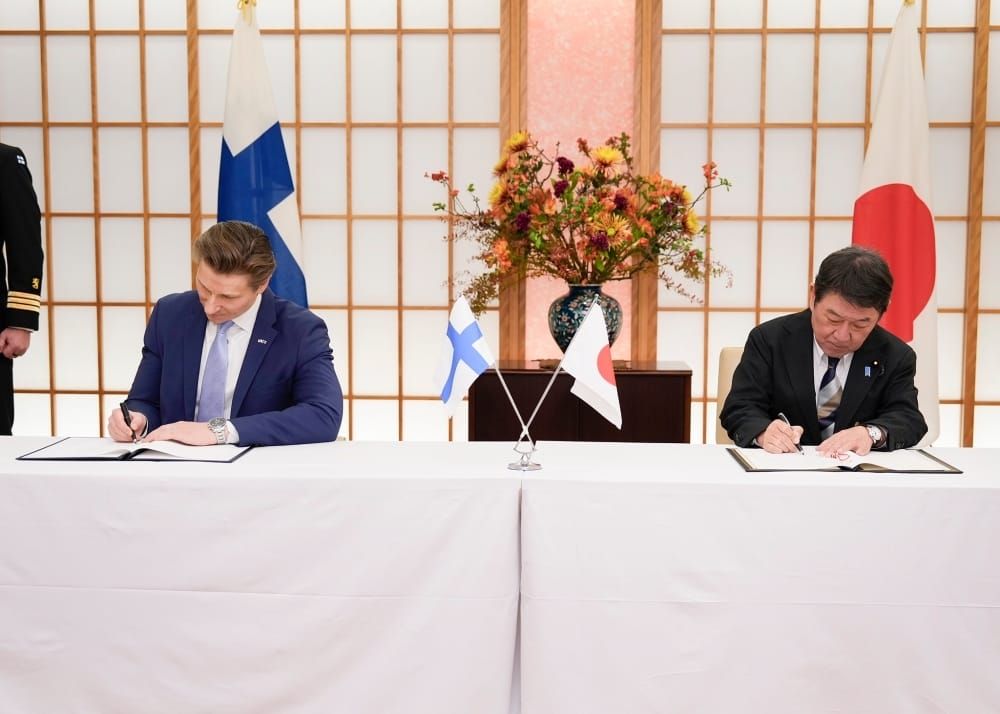
Finland has moved to strengthen defence cooperation with Australia and Japan in the space of four days, illustrating how European and Indo-Pacific governments are developing closer security relationships in response to an increasingly interconnected threat environment.
On 23 October, Finnish Defence Minister Antti Häkkänen and Australian Defence Minister Richard Marles agreed to deepen bilateral defence cooperation, including potential industrial partnerships and arrangements for sharing classified information.
Three days later, Häkkänen signed a defence equipment and technology transfer agreement with Japan, establishing a legal framework for closer military-industrial cooperation.
The announcements reflect more than a sequence of diplomatic visits. They demonstrate how a NATO member on Russia's border is seeking closer relationships with two major Indo-Pacific security partners.
However, the agreements are not equivalent. Japan and Finland have signed a formal technology transfer framework, while Australia and Finland are still exploring a proposed Defence Capability Memorandum of Understanding.
The distinction illustrates both the momentum and the limitations of emerging cooperation between Europe's defence industries and Indo-Pacific partners.
Finland looks beyond its European security environment
Finland's strategic priorities remain firmly rooted in European security.
The country joined NATO in 2023 following Russia's full-scale invasion of Ukraine and continues to place territorial defence, military readiness and support for Kyiv at the centre of its defence policy.
Its expanding engagement with Australia and Japan does not represent a move away from those commitments.
Instead, Helsinki appears to be seeking additional industrial, technological and operational partnerships with countries that share concerns about military coercion and the resilience of international security arrangements.
The similarities between the Australian and Japanese statements are striking.
Both explicitly recognise a connection between European and Indo-Pacific security.
In Tokyo, Japanese Foreign Minister Toshimitsu Motegi described the security of the two regions as inseparable.
Australia moves towards a deeper defence partnership
The Australia–Finland joint statement is particularly notable because it identifies practical areas of cooperation.
The two governments agreed to explore a Defence Capability Memorandum of Understanding intended to support resilient defence supply chains and cooperation between their industrial bases.
They also committed to examining arrangements for sharing classified information.
Neither measure has yet been finalised, and the statement does not announce a specific procurement contract.
Nevertheless, the relationship already includes operational engagement.
Finnish personnel participated in Australia's Exercise Pitch Black during July and August 2026, while Australian observers are expected to attend Finland's Exercise Protective Fence in November.
Both governments also identified future opportunities arising from Finland's introduction of F-35 fighters.
Their cooperation extends to Ukraine, where Australian and Finnish personnel are working together to train Ukrainian forces under the multinational Operation Legio.
Japan establishes a more formal industrial framework
Japan's agreement with Finland goes further in defining the legal conditions for defence technology cooperation.
Signed in Tokyo on 26 October, it establishes rules for transferring equipment and technology between the two governments.
The framework supports potential joint research, development and production while regulating third-party transfers and uses outside agreed purposes.
Such arrangements can reduce legal and administrative barriers to sensitive defence projects.
The agreement does not, however, commit either government to purchasing specific equipment or funding a particular joint programme.
Defence industry becomes a strategic link
Industrial capacity is an important connection between the Australian and Japanese developments.
European governments are seeking to expand defence production following years of pressure on ammunition inventories, equipment availability and military supply chains.
Indo-Pacific partners face their own requirements for advanced surveillance, communications, autonomous systems and resilient military technology.
Cooperation can offer access to complementary expertise, larger potential markets and opportunities to develop common or interoperable equipment.
Finland has particular strengths in armoured vehicles, secure communications, electronic warfare and space-based surveillance.
Australia and Japan are investing in several of the same technological areas.
From common interests to military capability
Finland's October engagements offer a useful measure of how European and Indo-Pacific security cooperation is evolving.
The agreement with Japan provides an established legal route for future defence equipment and technology transfers.
The Australian declaration identifies a broader capability partnership, with existing exercises and Ukraine-related cooperation supporting its development.
Both arrangements reflect a growing recognition that defence technology, industrial production and military readiness increasingly connect security developments across regions.

Comments ()