
Philippine Air Force S-70i Black Hawk training deal with Lockheed Martin
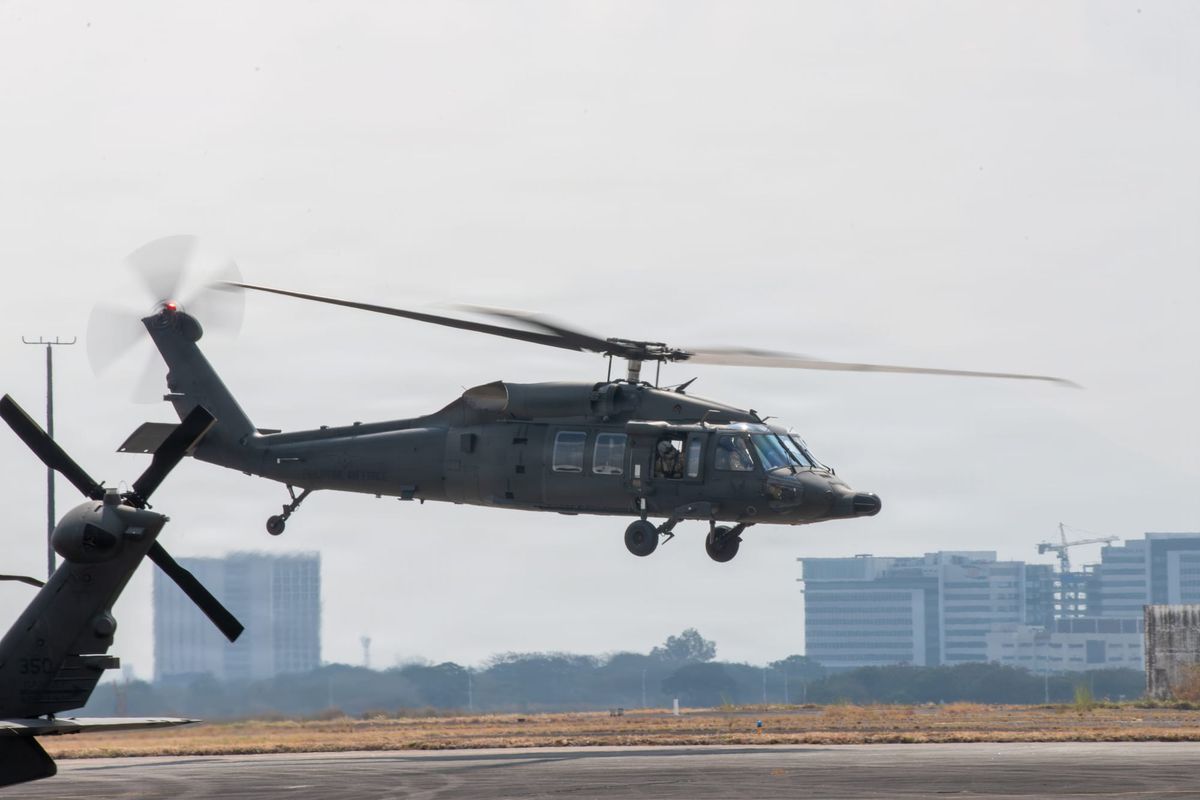
Lockheed Martin has signed a contract with the Philippine Department of National Defense to supply Black Hawk helicopter training equipment to the Philippine Air Force (PAF). The company announced the contract on 8 October. It said the package will allow the PAF to train its Black Hawk pilots and maintainers inside the country.
The contract is a Direct Commercial Sale, which means Manila bought the equipment directly from the company. Lockheed Martin did not disclose its value or a delivery date.
What the Philippines is buying
The package centres on an S-70i Black Hawk Full Flight Simulator and a Virtual Maintenance Trainer, with associated courseware. The contract also covers sustainment and spare parts support through 2032.
According to Lockheed Martin, the full flight simulator is built on a digital twin of the aircraft and recreates the experience of flying an S-70i. The maintenance trainer uses physics-based models of the helicopter's subsystems. The company said this lets maintainers train on everything from hydraulics to avionics in what it described as a fully immersive, risk-free environment.
The release said this is the first order for Lockheed Martin's own S-70i Black Hawk training devices.
Until the new capability is established, the release said, PAF pilots will continue to train at the Sikorsky Training Academy in the United States. Sikorsky is part of Lockheed Martin.
Tim James, Lockheed Martin's vice president of air and commercial solutions, described the award as "a long-term investment in the PAF's mission readiness".
The largest S-70i fleet
The training contract follows the completion of the PAF's Black Hawk deliveries in August. The Philippines now operates 47 S-70i helicopters, which makes it the world's largest operator of the S-70i variant, according to AeroTime and the Daily Tribune.
Manila bought the aircraft under two contracts. The first covered 16 helicopters, which Lockheed Martin said were delivered by December 2021. One of those aircraft was lost in a crash during night training in June 2021. A second contract for 32 more helicopters was signed in February 2022. Those aircraft arrived in batches from 2024, and the last seven were handed over at Villamor Air Base on 26 August.
The S-70i is built in Poland by PZL Mielec, a Lockheed Martin company. When the second contract was signed, Lockheed Martin said it was the largest single Black Hawk order for the Polish plant since S-70i production began in 2009.
The Lockheed Martin release said the PAF uses the Black Hawks for search and rescue and for humanitarian aid. It also listed firefighting and troop transport across the archipelago.
Why in-country training counts
A fleet of 47 helicopters needs a steady supply of qualified crews. The PAF already has some simulator training at home. In December 2025 it inaugurated a full-motion simulator at Benito Ebuen Air Base in Cebu, with interchangeable cockpits for the S-70i and the Bell 412EP, the Philippine News Agency reported. Lockheed Martin told Stars and Stripes in August that PAF pilots and maintainers train both in the United States and in the Philippines.
The new package adds the manufacturer's own full flight simulator and a dedicated maintenance trainer. That is likely to reduce the PAF's reliance on training abroad and could allow it to qualify more crews each year.
Simulators also allow crews to practise emergency procedures that would be unsafe or costly to rehearse in a real aircraft. For a force that flies rescue and disaster relief missions, that kind of practice is likely to be valuable.
The maintenance trainer could prove just as useful. Training them on a virtual aircraft avoids taking helicopters out of service for instruction.
Lockheed Martin said the contract supports the Philippines' wider defence modernisation. With the Black Hawk deliveries complete, the training package suggests Manila is also investing in keeping the fleet ready to fly.
What comes next
Lockheed Martin has not said when the simulator will be delivered or where it will be installed. No public comment from the PAF or the Department of National Defense could be found as of 9 October.
Until the new system is ready, part of the pilot pipeline will continue to run through the United States. The sustainment support runs through 2032, so Lockheed Martin will remain closely involved in the programme for about six more years.
Comments ()