
Japan Launches Shogei, Its Seventh Taigei-Class Submarine
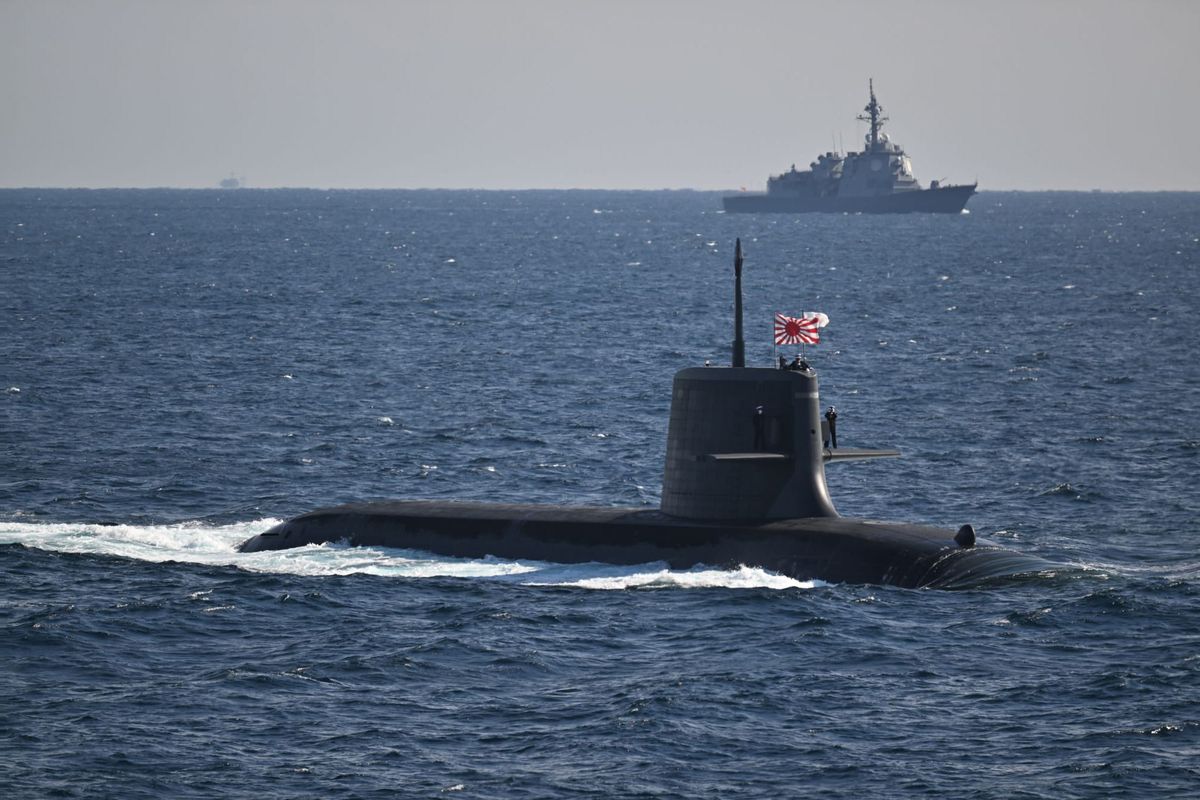
Japan launched its seventh Taigei-class submarine on 8 October, advancing a fleet renewal programme that combines lithium-ion batteries with improved detection to strengthen its underwater surveillance.
The new boat, Shogei, was named and launched at Mitsubishi Heavy Industries’ Kobe shipyard. MHI said it would now undergo outfitting before delivery to the Ministry of Defence during Japan’s financial year 2027, which ends in March 2028. The Taigei class succeeds the Soryu class in the Japan Maritime Self-Defense Force.
The programme already extends beyond the latest launch. Japan’s financial year 2026 defence budget allocates ¥120.8 billion to build the tenth Taigei, with enhanced detection and systems intended to reduce the workload on personnel.
Japan’s geography helps explain the emphasis on surveillance. Its south-western islands lie along the routes linking the East China Sea and the western Pacific. In an announcement on 24 August, Japan’s Joint Staff reported that two Chinese destroyers and two frigates had passed between Okinawa and Miyako towards the Pacific two days earlier.
Japan’s Defence Buildup Programme gives submarine units two linked roles: continuous intelligence gathering and surveillance in peacetime, and securing superiority underwater during a contingency. Its longer-term force plan includes 22 submarines. That places Taigei within a continuing requirement to sustain a capable underwater force.
The class has a standard displacement of about 3,000 tonnes and is 84 metres long. Its propulsion remains diesel-electric, with batteries supplying an electric motor when the boat operates submerged.
Lithium-ion batteries are central to the design. Kawasaki Heavy Industries, which builds Taigei submarines alongside MHI, says the battery system increases underwater endurance. The change began before this class: the preceding Soryu boats Oryu and Toryu also carried lithium-ion batteries, according to accounts published by the JMSDF and Ministry of Defence.
For a conventional submarine, battery endurance affects how long it can operate before returning close to the surface to run its diesel generators through a snorkel. That creates opportunities for an opponent to detect it. Greater endurance could allow longer periods watching shipping or holding a patrol position between recharges.
The Ministry of Defence also describes a new sonar system with improved detection, supported by a combat management system that makes better use of information from onboard equipment. The hull structure is designed to reduce the submarine’s signature, making it harder to detect.
Those improvements point to a boat intended to gather more useful information while limiting its own exposure. The builders’ launch announcements do not quantify the endurance gain or give sonar detection ranges. Its batteries still have to be recharged, and more demanding manoeuvres draw on the same finite supply of stored energy.
A submarine operating covertly around Japan’s south-western islands could help it follow naval movements without revealing its own position. In a conflict, uncertainty about where Japanese boats are operating could also force an opposing navy to commit ships and aircraft to searching for them. That is the strategic attraction of improved endurance and detection working together.
Construction has continued across both builders. MHI launched the fifth boat, Chogei, in October 2024, followed by Kawasaki’s launch of the sixth, Sogei, in October 2025. Shogei’s launch maintains that annual sequence while funding reaches further into the class.
A recurring programme can help retain specialist shipyard skills and sustain suppliers, while allowing experience from earlier boats to inform later construction. Delivery dates alone cannot establish how many submarines are available for patrols, which also depends on maintenance and trained crews.
The lead boat, Taigei, now serves as a test submarine. Its commanding officer says the vessel supports automation of submarine equipment and faster development. That gives the programme a dedicated platform for testing changes as further boats are built.
The practical challenge is getting more capability from the people available to operate and maintain the fleet. Japan’s maritime service lists a crew of about 70 for the class. MHI’s latest announcement identifies reducing manpower requirements as a continuing development priority, alongside cybersecurity and lower lifetime costs.
Japan’s longer-term plans also envisage submarines fitted with vertical launch systems to carry stand-off missiles. Separately, on 11 September, Defence Minister Shinjiro Koizumi said nuclear-powered submarines remained an option as Japan reviewed its security policy, while stressing that the government had not settled on an outcome. The Taigei construction programme continues while Tokyo considers how its future underwater force should be armed and powered.
Comments ()