
US Rebuilds Pacific Airfields to Disperse Warplanes, With Australia in Future Plans
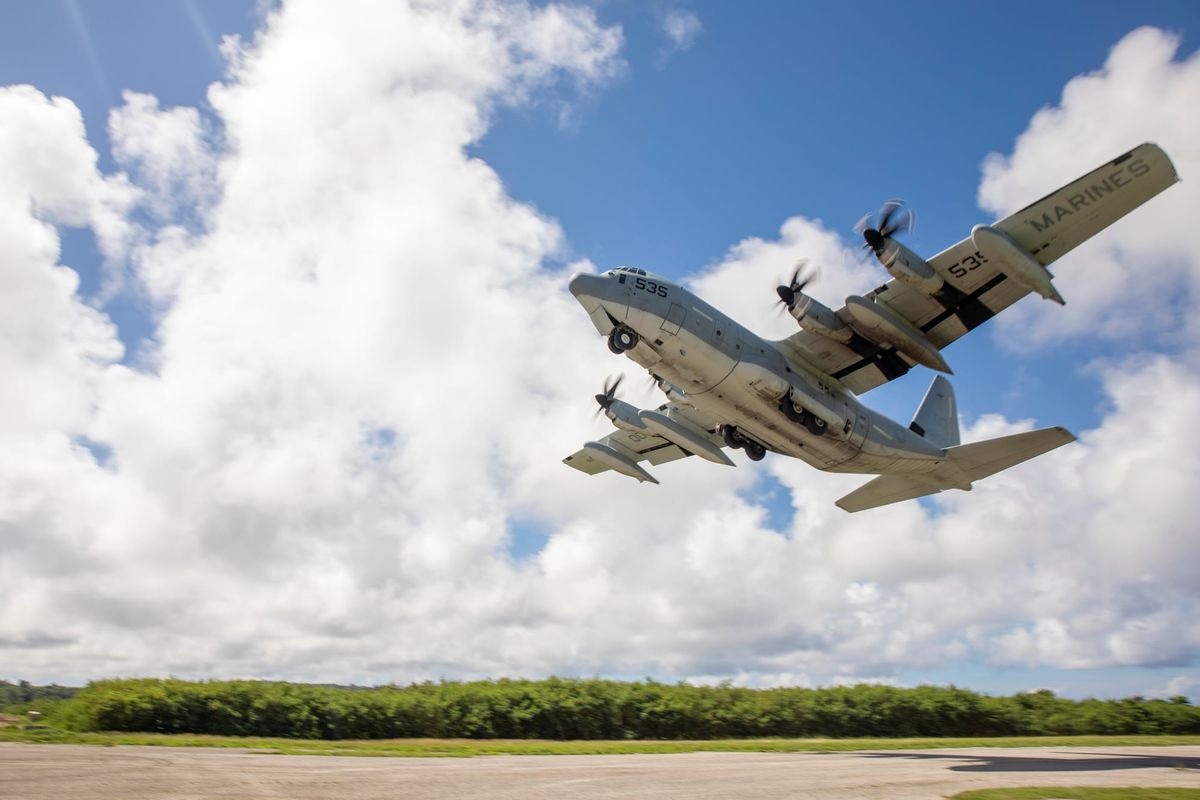
US Air Force engineers are restoring wartime runways and building military storage facilities across the Pacific, while considering Australia for future joint construction as Washington prepares to disperse aircraft beyond vulnerable major bases.
The US Air Force is advancing the restoration of Second World War airfields and constructing military storage facilities across the Pacific as it prepares to disperse combat aircraft away from major bases that could be targeted during a conflict with China.
An engineering deployment has nearly completed the groundwork for Runway Able on Tinian in the Northern Mariana Islands, while construction teams are assembling protective warehouses on Guam and at American military installations in Japan.
Australia has also emerged in the planning process for possible future joint construction, according to a US Air National Guard report published on 18 October.
The work forms part of the Air Force's Agile Combat Employment strategy, designed to complicate an adversary's targeting by spreading aircraft, personnel and equipment across a larger network of operating locations.
The engineering progress illustrates how Washington is turning that strategy into physical infrastructure, although significant construction and logistical challenges remain.
Tinian's wartime airfields return to service
The 513th Expeditionary RED HORSE Squadron, combining Air National Guard engineers from Virginia and Florida with active-duty personnel from Montana, has been working to restore abandoned aviation infrastructure on Tinian.
The island was a major American bomber base during the Second World War and is again becoming an important element of US military planning in the western Pacific.
According to the Air National Guard, the deployment completed 99% of demolition and compaction work on Runway Able and 90% of its stabilising base layer.
The squadron received 16,952 tonnes of asphalt for work on the runway and Tinian's north ramp.
Final paving remains dependent on the arrival of basalt stone, which must undergo two weeks of testing before approval.
The reported progress does not establish that the runway is ready for operational aircraft.
Other American engineering units have been restoring Tinian's historic North Field, while separate arrangements support the development of an aircraft-diversion facility at the island's civilian airport.
Together, the projects would provide additional operating options if established American air bases were damaged or temporarily unavailable.
Tinian's location, within reach of US facilities on Guam but separated from them geographically, makes it useful for distributing military aircraft and complicating an adversary's targeting calculations.
Warehouses and construction equipment move across the Pacific
The engineering effort extends beyond Tinian.
Across Andersen Air Force Base on Guam and military installations at Misawa and Atsugi in Japan, the squadron has been involved in assembling 20 steel K-Span warehouses intended to protect prepositioned military equipment and supplies.
Six warehouses at Misawa were reported to be 99% complete. Construction also advanced at Andersen and Atsugi, although the Air National Guard did not describe all 20 buildings as finished.
The squadron is leaving one mobile asphalt plant on Guam, while another is being prepared for transfer to Peleliu in Palau.
Such equipment allows engineering teams to construct and repair surfaces closer to potential operating locations rather than depend entirely on materials and machinery dispatched from larger bases.
The rotation also exposed the difficulties of building infrastructure across scattered Pacific islands.
Engineers encountered unusually hard coral and limestone, a shortage of suitable construction materials and severe weather, including two Category 5 typhoons.
Heavy machinery and supplies had to move between islands aboard civilian vessels because the unit lacked dedicated military cargo aircraft for that task.
These constraints would become more consequential during a conflict, when shipping routes, ports and airfields could themselves be threatened.
Why dispersed air power needs permanent groundwork
Agile Combat Employment is intended to reduce the vulnerability created by concentrating aircraft at a limited number of large installations.
China's expanding inventory of long-range missiles and surveillance capabilities increases the risks facing established American bases in the western Pacific.
Dispersing aircraft across multiple locations would force an adversary to identify, monitor and potentially attack more targets.
But operating from smaller airfields requires considerably more than an intact runway.
Aircraft need fuel, ammunition, ground support equipment, maintenance personnel and secure communications. Sites also require protection and reliable routes for replenishment.
The Air Force's doctrine therefore places sustainment alongside mobility and survivability.
The construction on Tinian, Guam and in Japan provides some of that supporting infrastructure before a crisis begins.
Even so, dispersed facilities are not immune to attack. Small operating locations may be harder to defend, and their usefulness depends on how quickly aircraft can relocate, be serviced and return to operations.
The engineering programme expands American options without eliminating the logistical vulnerabilities of fighting across the Pacific.
Australia enters the construction planning
The Air National Guard report identifies Australia among three countries being considered for potential future joint construction, alongside the Philippines and Japan.
It says the squadron is coordinating with regional planning and engineering organisations, but names no Australian project, location, budget or timetable.
Australia already hosts substantial US military infrastructure and force-posture cooperation under separate bilateral arrangements.
At the December 2025 AUSMIN consultations, Canberra and Washington committed to advancing works at RAAF Bases Tindal and Darwin to support rotations of American bombers, fighters and intelligence, surveillance and reconnaissance aircraft.
They also agreed to examine possible infrastructure works at RAAF Base Amberley and establish northern and southern nodes within combined logistics networks in Australia.
Australia's Defence Department says airfield infrastructure work at Tindal, which also supports US aircraft operations, is scheduled to continue through late 2027.
The RED HORSE reference therefore comes against an established programme of bilateral investment. It does not establish that the unit has been assigned a new Australian construction project.
Any additional works would require planning, approvals and agreement between the two governments.
Building capacity before a crisis
The latest rotation demonstrates both the scale and the limitations of American preparations for dispersed air operations.
Runway restoration, protective warehouses and mobile construction equipment could help US aircraft operate from more locations and recover from damage to established bases.
But substantial work remains unfinished, and the engineering effort itself has encountered transport and supply problems under peacetime conditions.
For Australia, the prospect of additional joint construction points to a potentially expanding role in the infrastructure supporting US air operations across the Indo-Pacific.
Comments ()