
US Marines Test Satellite-Independent Link Between Philippines and Australia
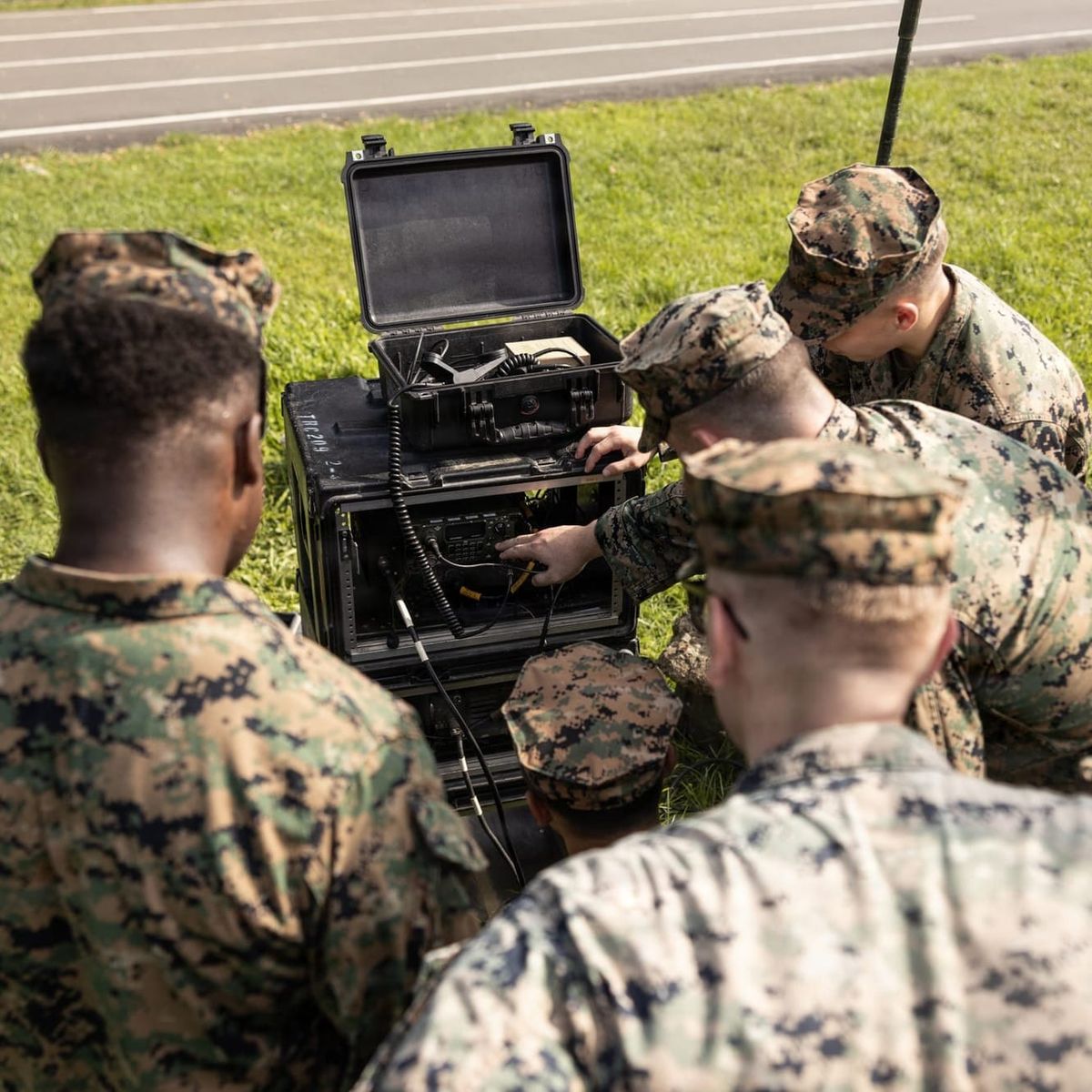
US Marines have established a direct high-frequency radio link between the Philippines and northern Australia, demonstrating how two increasingly important forward forces could remain connected if satellite communications were disrupted.
The test linked Marine Rotational Force-Southeast Asia in Manila with Marine Rotational Force-Darwin, approximately 3,200 kilometres away. On 23 July, Marines used an AN/PRC-160 radio paired with a TRC-209 amplifier to conduct two-way voice communications between the two countries.
According to the Marine Corps release, the same distance could be covered using a man-portable AN/PRC-160 and a field-expedient directional antenna. The larger amplifier provides more power for fixed command posts, but is not essential to the basic capability.
High-frequency radio offers one answer to a central problem facing the US military in the Indo-Pacific. American forces plan to disperse across islands and temporary operating locations, reducing their dependence on a small number of large bases.
Commanders must still communicate across thousands of kilometres while Chinese forces attempt to disrupt satellites and data networks.
HF signals can travel beyond the horizon by using the ionosphere, allowing units to communicate over long distances without satellites or relay stations. Modern radios add encryption and automated frequency selection, features intended to make transmissions harder to intercept or jam.
The connection between Manila and Darwin is especially significant because the role of both Marine forces is expanding.
MRF-SEA began operating in 2023 as a rotational force moving between several Southeast Asian countries. Its most recent rotation ran from October until late March, overlapping the period when MRF-D deploys to Australia.
That pattern changed this year. When the 15th Marine Expeditionary Unit completed its MRF-SEA deployment on 31 March, a new I Marine Expeditionary Force command element arrived to continue the mission with a more concentrated presence in the Philippines.
MRF-SEA now serves as a forward command element supporting Task Force-Philippines and working with the Philippine military on its Comprehensive Archipelagic Defense Concept. Its extended deployment means it is operating alongside the Darwin force rather than largely alternating with it.
MRF-D is also becoming more operationally capable. The 2026 rotation became the first in the programme's 15-year history to qualify as a Special Purpose Marine Air-Ground Task Force. Its certification covered tasks ranging from crisis response to expeditionary advanced base operations.
The radio test therefore offers a glimpse of an emerging regional structure.
The Philippines provides access close to the South China Sea and Luzon Strait, while northern Australia offers greater strategic depth and space for logistics and reinforcement. A direct communications pathway helps connect these positions without relying entirely on more vulnerable space-based systems.
The demonstration remains limited. It involved two-way voice communications, rather than the high-volume exchange of targeting and surveillance data required by a modern combat network.
HF performance also varies with atmospheric conditions and operator skill, while its transmissions can still be detected and jammed.
Its value is that it gives the Marines another way to communicate if their primary networks fail. As the Marines build a more dispersed force across the Indo-Pacific, an old communications method is providing another way to keep its emerging network connected.

Comments ()