
US Marines establish first NMESIS anti-ship missile battalion
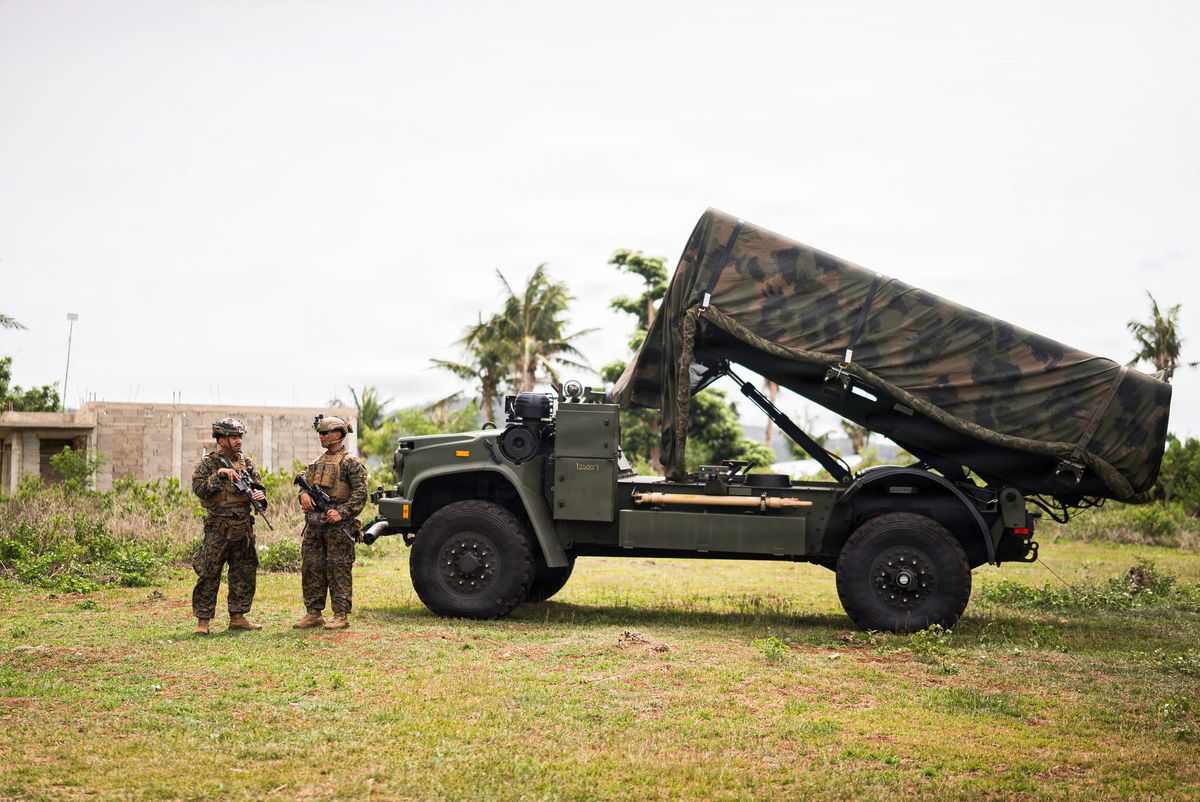
The US Marine Corps has converted an artillery battalion into its first medium missile battalion, expanding land-based anti-ship capabilities beyond the Pacific-focused Marine Littoral Regiments.
The US Marine Corps has established its first medium missile battalion, converting an existing artillery formation into a unit centred on the Navy-Marine Expeditionary Ship Interdiction System (NMESIS), a mobile launcher designed to attack enemy warships from land.
The 1st Battalion, 10th Marine Regiment, part of the 2nd Marine Division, was formally redesignated during a ceremony at Camp Lejeune, North Carolina, on 9 October.
The move forms part of the Marine Corps' Force Design modernisation programme, which is restructuring formations to support distributed operations and maritime warfare.
"The requirement for the Marine Corps to have a land-based capability to conduct sea denial was identified as a crucial step to facilitate the maritime component commanders to fight for sea control," said Lieutenant Colonel Joseph Mozzi, the battalion's commanding officer.
NMESIS expands Marine Corps anti-ship capability
NMESIS combines an unmanned, remotely operated ground vehicle with a launcher capable of carrying two Naval Strike Missiles (NSM).
According to the Marine Corps, the missiles have an effective range exceeding 130 nautical miles (approximately 240 kilometres), allowing units positioned along coastlines or on islands to engage hostile surface ships at considerable distances.
The system is designed for deployment in austere environments, supporting the Marine Corps' efforts to distribute precision-strike capabilities across contested maritime areas.
NMESIS is not new to the service. The Hawaii-based 3rd Marine Littoral Regiment formally received the system in November 2024, while the Okinawa-based 12th Marine Littoral Regiment received its launchers in June 2026.
The latest redesignation is significant because it marks the first conversion of a Marine artillery battalion into a dedicated missile battalion, extending the capability beyond specialised Marine Littoral Regiments.
A shift in Marine Corps force structure
The new battalion gives II Marine Expeditionary Force, headquartered at Camp Lejeune, additional options for deploying land-based anti-ship missiles during a crisis.
Colonel William Soucie, commander of the 10th Marine Regiment, said the system would allow Marines to provide fire support not only to forces operating ashore but also to naval operations at sea.
Soucie said the missiles complement rather than replace cannon artillery, which the regiment will retain in another battalion.
The restructuring reflects a broader change in how the Marine Corps expects to support naval campaigns.
Ground forces equipped with anti-ship missiles could help deny adversaries access to strategically important waters, protect maritime approaches and complicate the movement of hostile surface forces.
Although Marine Littoral Regiments remain central to this concept in the Indo-Pacific, the establishment of a dedicated missile battalion within the 2nd Marine Division suggests the service is extending sea-denial responsibilities across its wider force.
The Marine Corps has not disclosed the new battalion's launcher inventory or confirmed when it will achieve full operational readiness.
Nevertheless, the redesignation marks another step towards integrating land-based anti-ship missiles into the Marine Corps' conventional combat formations.
Comments ()