
The US Army Is Building the Supply Network for a Long War With China
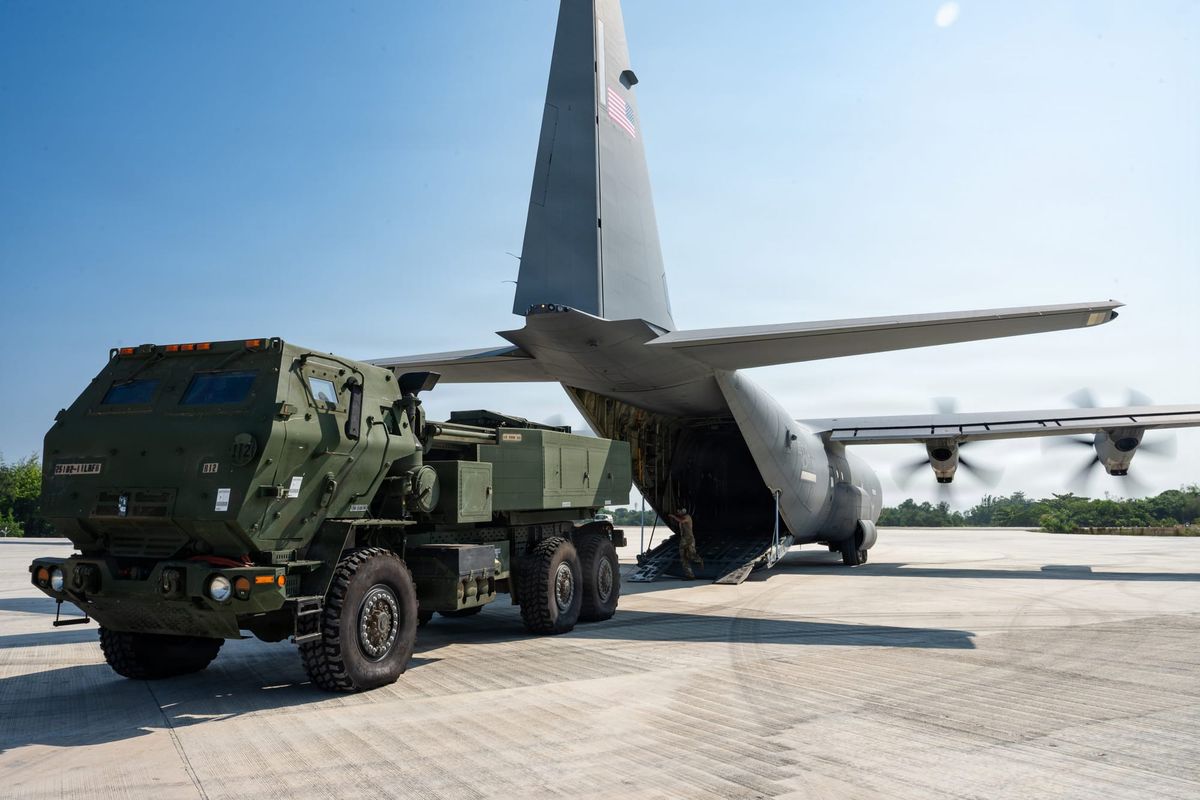
New American warfighting guidance calls for forward-positioned missiles, protected ammunition stocks and resilient supply networks across the Pacific, acknowledging that sustaining a prolonged conflict could prove as difficult as fighting its opening battles.
The US Army is preparing for a prolonged conflict in the Western Pacific by expanding forward-positioned weapons, hardening ammunition and fuel storage, and developing supply networks capable of operating under Chinese military attack.
Its new operational guidance, How the Army Fights, released on 7 October, identifies the People's Liberation Army (PLA) as the service's pacing threat and calls for American forces to be ready to fight from the opening day of a conflict.
The document concentrates on the First Island Chain, the arc of islands extending broadly from Japan through Taiwan to the Philippines, where American forces would operate within reach of China's expanding missile and surveillance networks.
Rather than rely on reinforcements arriving after hostilities begin, the Army wants weapons, equipment and essential supplies positioned closer to potential operational areas.
Sustaining those forces presents a formidable challenge. China's ability to threaten ports, airfields, logistics centres and supply routes could disrupt American reinforcements and supplies throughout a prolonged campaign.
The Army's answer is to establish the infrastructure needed to fight immediately and maintain operations despite sustained attacks on its logistics network.
Preparing to fight from day one
The guidance calls for greater long-range precision fires capacity and munitions stocks inside the First Island Chain, enabling American forces to interdict adversary launch sites and maritime targets.
Forward-positioned Multi-Domain Task Forces would combine long-range strike capabilities with air and missile defence, electronic warfare and other systems designed to disrupt China's anti-access networks.
Near-term priorities include bulk fuel and ammunition storage, improved contingency facilities and resilient command-and-control infrastructure.
The Army also intends to expand Total Army Power Projection Equipment (TAP2E), the new designation for Army Prepositioned Stocks.
These overseas equipment and supply reserves are intended to support rotational forces and units arriving during a crisis, reducing their dependence on lengthy deployments from the continental United States.
The document describes forward-deployed forces as "postured to act immediately on day one of a conflict".
Their effectiveness, however, depends on reliable access to allied territory, functioning communications and the ability to replenish ammunition and fuel as operations continue.
The Second Island Chain becomes a logistics priority
Across the Second Island Chain, which includes Guam, the Army is expanding protected fuel and munitions storage, improving distribution networks and forward-deploying engineering, medical and air-defence assets.
These facilities would provide additional operational depth, supporting American and allied forces operating closer to China.
But greater distance from the Chinese mainland does not guarantee safety. Long-range missiles and persistent surveillance could threaten logistics facilities once considered relatively secure.
The Army is therefore exploring more dispersed distribution arrangements, including autonomous ground, air and littoral systems.
A hypothetical 2027 scenario in the guidance envisages Army watercraft and uncrewed platforms delivering ammunition to dispersed missile and air-defence formations in northern Luzon.
The scenario illustrates an intended approach to battlefield logistics rather than a capability already established in operational service.
Dispersed storage and alternative transport routes could reduce dependence on vulnerable ports and depots, although they would also increase the complexity of coordinating supplies across the theatre.
The munitions challenge
The guidance acknowledges that prolonged high-intensity warfare would place severe pressure on American ammunition reserves and industrial production.
Long-range precision missiles are central to the Army's plans, but their cost and manufacturing requirements limit how quickly they can be replenished.
The Army consequently calls for lower-cost, scalable munitions alongside more expensive precision weapons.
Recent conflicts have demonstrated how ammunition consumption can outpace peacetime production, and a prolonged Pacific campaign would add the difficulty of transporting supplies through contested waters and airspace.
The Army wants greater magazine depth, expanded production capacity and more resilient equipment maintenance and repair arrangements.
Funding remains a constraint. The guidance assumes the Army's base budget will remain broadly flat in real terms, increasing pressure to prioritise investments in munitions, protected infrastructure and sustainment.
The ability to replace weapons and repair equipment could determine how long forward-positioned forces remain effective.
Australia is already part of the logistics build-up
Australia is already contributing to the US Army's expanding Indo-Pacific sustainment network.
In June 2026, Army Materiel Command confirmed that it was establishing prepositioned equipment stocks in Australia and the Philippines to improve supply-chain resilience and reduce reliance on deployments from the United States.
The command also emphasised the importance of equipment maintenance, customs arrangements and exercises to ensure stored supplies could be accessed when required.
Australia's ports, airfields and established military cooperation with Washington provide opportunities to support forces operating farther north.
However, the October guidance does not announce additional Australian facilities or specific new funding commitments.
Any further expansion would require infrastructure investment, host-nation agreements and measures to protect military logistics installations.
For Canberra, these arrangements could support American operations while improving the resilience of Australia's own military supply networks.
Turning guidance into military capability
American units have already rehearsed equipment deployments through Philippine ports and airfields, demonstrating elements of the dispersed posture envisaged by the Army.
But the October document is operational guidance, not a detailed war plan or confirmation that every proposed facility, weapons stockpile or autonomous distribution system has been funded.
Implementation will depend on resources, allied cooperation and the ability to protect dispersed logistics infrastructure.
American military operations have long relied on the capacity to deploy substantial forces overseas and sustain them through established transport networks.
A conflict with China could challenge that model from its opening hours.
The Army is seeking to position more capability before fighting begins while developing supply networks that can continue operating under attack.
Comments ()