
US Air Force establishes $16.1bn ceiling for advanced propulsion contracts
The Pentagon's latest contract awards also include up to $1.53 billion for Trident II D5 missile production and support, alongside additional spending on nuclear weapons guidance and naval surveillance.
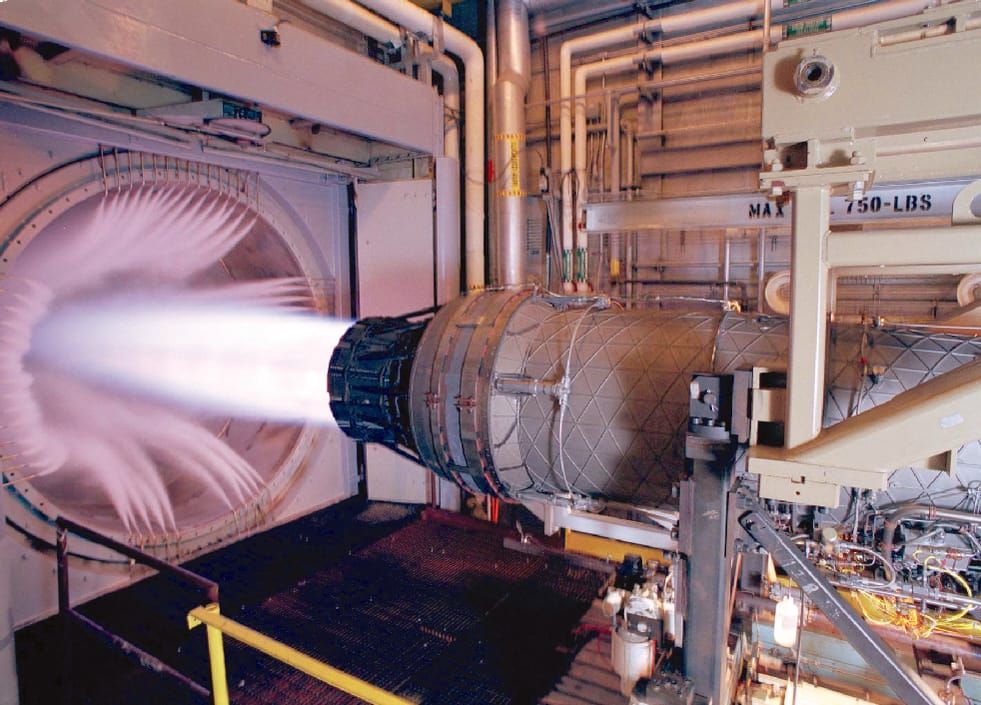
The US Air Force has established a $16.1 billion contracting ceiling for advanced propulsion development, creating a long-term mechanism through which dozens of aerospace and defence companies can compete for future work.
The indefinite-delivery/indefinite-quantity (IDIQ) awards, announced in the Pentagon's 20 November contracts bulletin, cover propulsion technology development across multiple stages of the research, engineering and production lifecycle.
The programme is expected to run until November 2041, giving the Air Force a framework for placing individual orders as requirements emerge.
Crucially, the $16.1 billion figure represents a cumulative maximum ceiling, not an immediate expenditure commitment.
Only $58,000 in fiscal 2027 research, development, test and evaluation funding was obligated at the time of award.
Major aerospace companies join propulsion framework
The awardees include Boeing, General Electric, Lockheed Martin, Northrop Grumman, RTX, Rolls-Royce North American Technologies, Honeywell, Aerojet Rocketdyne, Safran Defense & Space and Williams International.
Smaller propulsion specialists, including Hermeus and Whisper Aero, also appear among the recipients.
The Air Force described the programme as supporting the continuing enhancement of propulsion technology across all areas and lifecycle phases of development.
The bulletin does not identify specific engines, aircraft programmes or propulsion architectures that will receive funding under subsequent orders.
The framework nevertheless creates a contracting vehicle through which the Air Force can draw on established manufacturers and emerging technology developers without conducting a new overarching procurement competition for every requirement.
The eventual scale of spending will depend on orders placed against the ceiling.
Lockheed Martin receives Trident D5 modification
The same bulletin records a separate Navy contract action involving the US sea-based nuclear deterrent.
Lockheed Martin received an unpriced letter contract modification with a not-to-exceed value of $1,533,124,563 for Trident II D5 missile production and deployed systems support.
The sole-source modification covers work at facilities including Magna, Utah; Cape Canaveral, Florida; Denver, Colorado; Titusville, Florida; and the submarine bases at Kings Bay, Georgia, and Bangor, Washington.
Work is expected to continue until 30 September 2031.
The Trident II D5 is the submarine-launched ballistic missile used by the US Navy's strategic ballistic missile submarines and forms a central component of America's nuclear deterrent.
Because the modification is an unpriced letter contract, its maximum value should not be interpreted as funding already obligated or as a final negotiated contract price.
Additional support for missile guidance and naval operations
The Charles Stark Draper Laboratory received a $315.7 million cost-plus-fixed-fee modification for specialised engineering support to the Trident II D5 guidance subsystem.
Unlike the Lockheed Martin action, the Pentagon said the full Draper modification amount would be obligated from fiscal 2027 Navy weapons procurement funds. Work is scheduled for completion in September 2028.
Separately, Crowley Government Services received a $270.4 million contract to operate and maintain six government-owned ocean surveillance and missile-range instrumentation ships, including USNS Impeccable and USNS Howard O. Lorenzen.
Other awards included an $871 million ceiling for F108 engine sustainment and a $72.6 million modification covering F-35 Block 4 programme management, software engineering and cybersecurity support.
Together, the announcements span future propulsion development, strategic missile sustainment and ongoing naval operations.
Their headline values, however, represent different contractual instruments. The propulsion award establishes a shared long-term ceiling, while the Trident modification authorises work subject to a specified maximum. Neither figure should be treated as equivalent to money immediately spent.
Comments ()