
Germany's First F-35 Marks a Change in NATO Nuclear Sharing
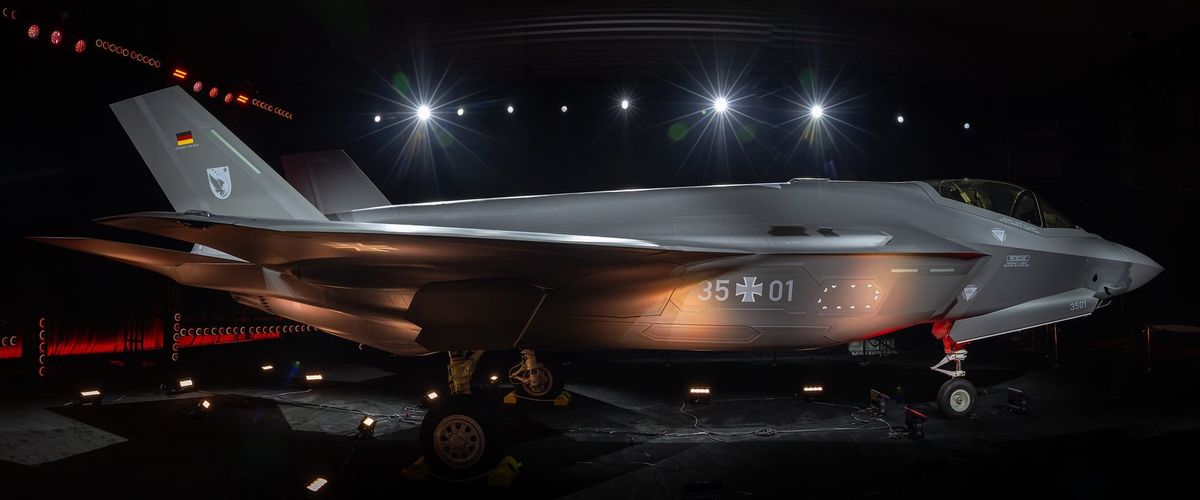
Germany's first F-35A was unveiled at Lockheed Martin's Fort Worth plant on 18 September, beginning a transition that reaches beyond the modernisation of the Luftwaffe.
Berlin ordered 35 aircraft in 2022 after Russia's full-scale invasion of Ukraine. The F-35 will gradually replace the Tornado in several roles, including Germany's contribution to NATO's nuclear-sharing arrangements.
Under nuclear sharing, selected European allies provide aircraft and crews capable of delivering US nuclear weapons in a conflict, while the weapons remain under US control in peacetime. Germany's ageing Tornado fleet has carried that responsibility for decades.
So, the F-35 provides continuity for the mission while embedding Germany more deeply in the combat-air system being adopted across Europe. Fourteen NATO members now operate the aircraft or plan to acquire it, giving the alliance a common platform for training, maintenance and high-end air operations.
German Defence Minister Boris Pistorius described the rollout as the beginning of a new era for the Luftwaffe. He highlighted the aircraft's low-observable design, sensor fusion and ability to assemble information from across the battlespace.
Those capabilities allow the F-35 to operate as a source of targeting and situational-awareness data for other forces as well as a strike aircraft.
This is important for NATO planning against Russia for several reasons. A larger European F-35 fleet should make it easier for allies to combine aircraft, crews and support during a crisis. Germany's political and military weight also makes its choice more consequential than the size of the 35-aircraft order alone suggests.
However, the transition will remain gradual. Germany's first eight F-35s are due to be delivered to Ebbing Air National Guard Base in Arkansas for pilot training. The first aircraft are scheduled to arrive in Germany in late 2027, and the Luftwaffe expects full operational capability in 2029.
The Fort Worth ceremony therefore marks the start of the process rather than an immediate increase in NATO combat power.
The purchase also carries a longer-term political cost. Germany is tying a critical air and nuclear mission to a US aircraft, software ecosystem and sustainment network at a time when European governments are debating greater strategic autonomy. The collapse this year of the joint Franco-German fighter at the centre of the Future Combat Air System has made that tension more visible.
Berlin has nevertheless made its near-term priority clear.
Preserving the nuclear-sharing role and fielding a survivable aircraft against modern Russian air defences outweigh the attraction of waiting for a future European platform, and Germany's first F-35 is tangible evidence of that choice.
Comments ()