
F-35C completes Ford-class carrier trials in major US naval aviation milestone
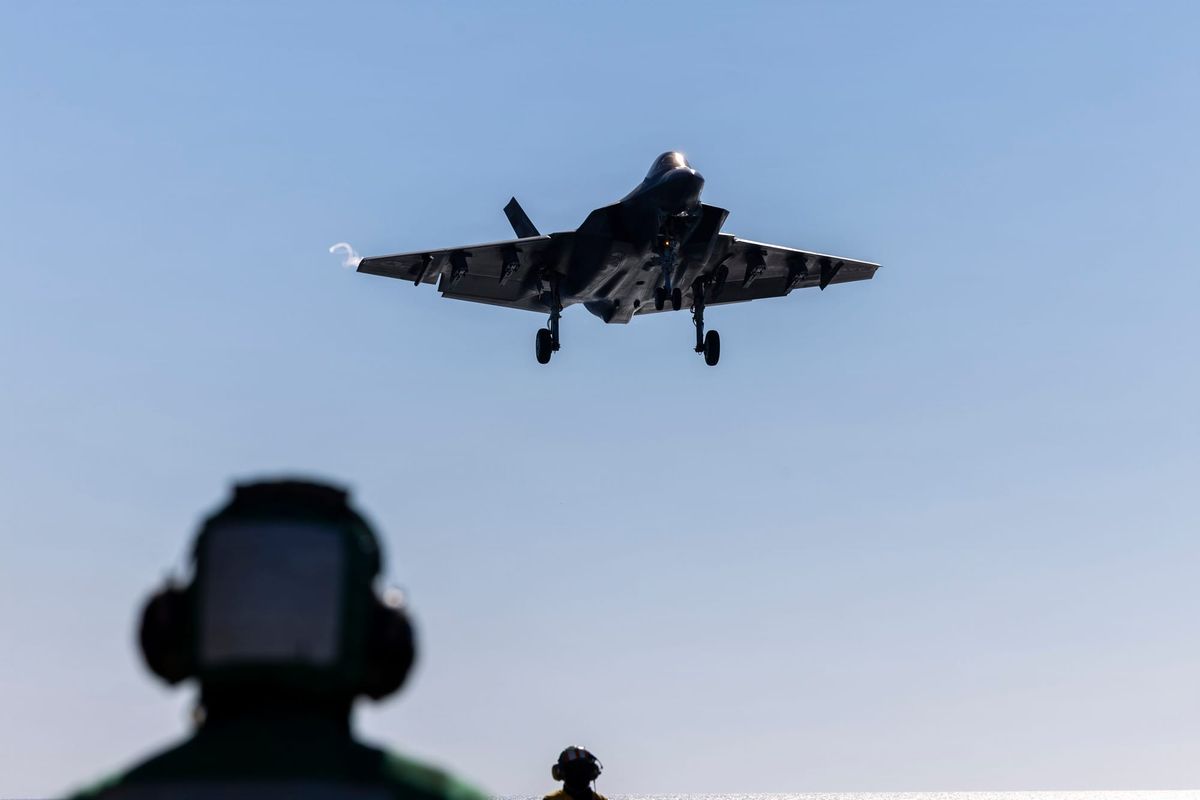
Lockheed Martin says two F-35C fighters completed 122 launches and arrested landings aboard the future USS John F. Kennedy, demonstrating compatibility with the US Navy's newest carrier technology.
The US Navy has completed a significant phase of F-35C carrier compatibility testing aboard the future USS John F. Kennedy, demonstrating the stealth fighter's ability to launch and recover using the systems installed on the Gerald R. Ford class of aircraft carriers.
According to an announcement issued by manufacturer Lockheed Martin on 19 November, two F-35C aircraft from Naval Air Station Patuxent River conducted 34 flights, 122 catapult launches and 122 arrested landings during 11 days of testing.
The first recovery aboard the carrier occurred on 13 October, meaning the announcement describes an earlier testing milestone rather than an operation conducted this week.
The results represent an important step in integrating fifth-generation naval aviation with the Navy's newest carrier design.
Testing a new generation of carrier systems
The F-35C is the carrier-based variant of the Lightning II fighter family, designed for catapult-assisted take-offs and arrested landings aboard large-deck aircraft carriers.
The Ford class introduces significant changes to the systems used to launch and recover fixed-wing aircraft.
Its Electromagnetic Aircraft Launch System, or EMALS, replaces the steam-powered catapults used on previous generations of American carriers.
EMALS uses electromagnetic energy to accelerate aircraft along the flight deck, allowing more precise control of launch forces across different aircraft configurations.
The Advanced Arresting Gear system performs a corresponding function during recovery, absorbing the energy of landing aircraft after their arresting hooks engage the deck cables.
These systems are central to the Ford-class design, but their integration with individual aircraft types requires detailed verification.
What the F-35C trials established
Lockheed Martin said the test campaign followed shore-based trials conducted between January 2024 and May 2025.
The shipboard programme was designed to validate launch and recovery characteristics, assess structural loading and verify the interaction between the fighter and the carrier's equipment.
The integrated test team also gathered information needed to develop aircraft launch and recovery guidance for Ford-class operations.
These technical requirements may appear less consequential than the introduction of a new weapon or combat aircraft, but they are essential to the safe and predictable operation of carrier aviation.
Aircraft compatibility testing establishes the conditions within which pilots and flight-deck crews can conduct routine operations.
The campaign also assessed the stability of the F-35C's mission systems, including initial Block 4 software use in a carrier environment
Operational significance for the US Navy
The F-35C provides the Navy with a carrier-based stealth fighter incorporating advanced sensors, electronic systems and data-sharing capabilities.
Its integration with newer carriers is relevant to the Navy's ability to operate in contested maritime environments, where opposing forces may possess sophisticated air defences, long-range missiles and extensive surveillance networks.
Fifth-generation fighters can contribute to intelligence collection, targeting and survivability in such environments.
John F. Kennedy remains in development
But the carrier's own programme status provides an important qualification.
In September, the US Navy announced preliminary acceptance of the future USS John F. Kennedy following acceptance trials in August.
The milestone enabled the vessel and its crew to undertake further sea testing while the shipbuilder continued work ahead of formal delivery, planned for spring 2027.
Comments ()