
How China's growing satellite network is reshaping Indo-Pacific warfare
China's accelerating space programme is becoming an increasingly important part of its military modernisation, with a growing satellite network supporting the People's Liberation Army's ability to detect, track and potentially target US and allied forces across the Indo-Pacific.
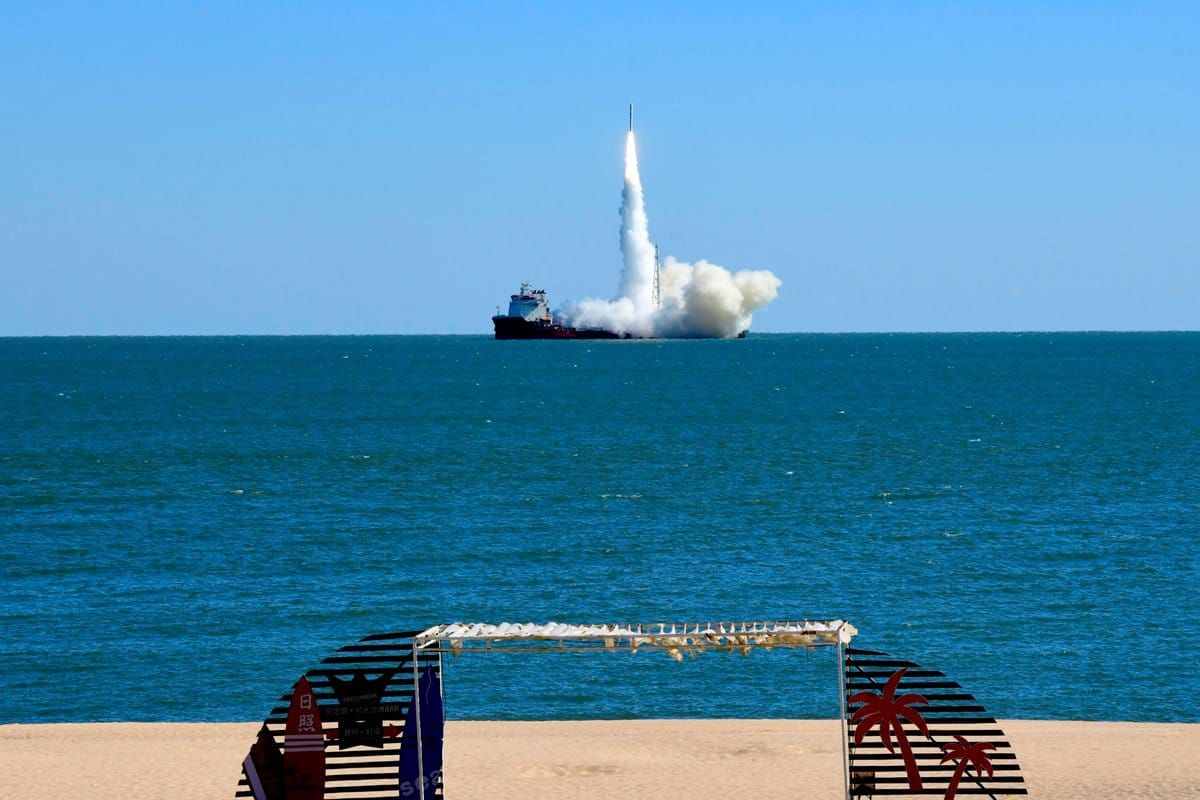
On 21 October, China launched a CERES-1 Y8 rocket from waters off Shandong province, placing a satellite into orbit in an operation carried out by the Taiyuan Satellite Launch Center.
The launch demonstrated China's growing use of maritime launch facilities, providing another means of placing payloads into orbit. The satellite was described as a commercial remote-sensing payload, but the mission came amid a wider expansion of China's space infrastructure.
That expansion includes reconnaissance satellites, communications constellations and ground systems supporting increasingly sophisticated military operations.
China's expanding surveillance network
On 10 September, China launched two groups of Yaogan remote-sensing satellites from the Jiuquan Satellite Launch Center. Another group followed on 24 September from Taiyuan.
Chinese state media described the launches as supporting scientific research, resource surveys and electromagnetic environment detection.
The wider Yaogan programme includes satellites with optical, radar and electronic intelligence collection capabilities, according to US military assessments.
A US Space Force threat assessment updated in July 2026 reported that China operates more than 510 intelligence, surveillance and reconnaissance-capable satellites.
These spacecraft use optical, multispectral, radar and radiofrequency sensors, increasing China's ability to detect US aircraft carriers, expeditionary forces and air wings, the Space Force said.
The figure covers China's wider surveillance-capable satellite inventory, rather than the Yaogan constellation alone. It does not establish that every satellite counted is exclusively military.
A March 2026 Japanese Ministry of Defense document also reported that China's military satellite numbers had increased approximately sixfold since 2012.
Together, these assessments describe a substantial increase in the orbital infrastructure available to support Chinese military operations.
From surveillance to missile targeting
The strategic significance extends beyond the number of satellites China operates.
Modern long-range missiles require reliable information about a target's location, movement and identity. This becomes particularly difficult against aircraft carriers and other warships operating hundreds or thousands of kilometres from Chinese territory.
Reconnaissance satellites can contribute by collecting imagery, identifying electronic emissions and supplying information to command networks.
Different sensors offer complementary advantages. Radar satellites can observe through cloud cover, while electronic intelligence satellites can help locate radar and communications transmissions.
US Space Command's 2026 posture statement describes China's growing space architecture as part of a targeting network intended to locate and engage American and allied forces using long-range precision weapons.
For the PLA, better targeting information could improve the effectiveness of anti-ship ballistic missiles and other weapons intended to restrict opposing forces' freedom of manoeuvre.
Yet detecting a vessel does not automatically provide the continuously updated targeting information needed for a successful strike.
Satellite revisit intervals, data-processing delays, communications resilience and the difficulty of distinguishing military targets from other vessels all affect performance.
Public information does not establish how reliably China can integrate its surveillance systems into a functioning targeting network under wartime conditions.
Australia and Japan respond
The expansion has implications for Australia, Japan and the United States, whose military operations depend heavily on satellite communications, navigation and intelligence.
Australia's 2026 Integrated Investment Program allocates between A$9.08 billion and A$12.28 billion over the decade to enhanced space capabilities focused on resilient communications, space domain awareness and space control.
Among the investments is cooperation with the United States and United Kingdom on the Deep Space Advanced Radar Capability, intended to improve the detection, tracking and identification of objects in orbit.
In November 2024, Defence ceased its procurement of a single-orbit geostationary satellite communications system from Lockheed Martin Australia, saying it would instead prioritise a multi-orbit capability to increase resilience.
These investments reflect the growing importance of maintaining communications and situational awareness when space systems face interference or attack.
Japan's defence planning similarly emphasises stronger space surveillance and the protection of satellite-dependent military operations.
For both countries, China's expanding satellite network adds another consideration to regional defence planning: the need to operate effectively when military movements are increasingly exposed to observation from orbit.
The changing balance in space
China's growing satellite fleet is improving the surveillance infrastructure available to its armed forces, while expanding launch capacity offers additional ways to replenish and develop that network.
The military implications depend on how effectively the PLA combines orbital surveillance with aircraft, ships, ground-based sensors and missile forces.
The expanding network nevertheless presents a strategic challenge for the United States and its allies, whose ability to manoeuvre, communicate and concentrate forces across the Indo-Pacific may increasingly depend on their capacity to operate under persistent surveillance.

Comments ()