
Australian HIMARS fire overseas for first time in Indonesia exercise
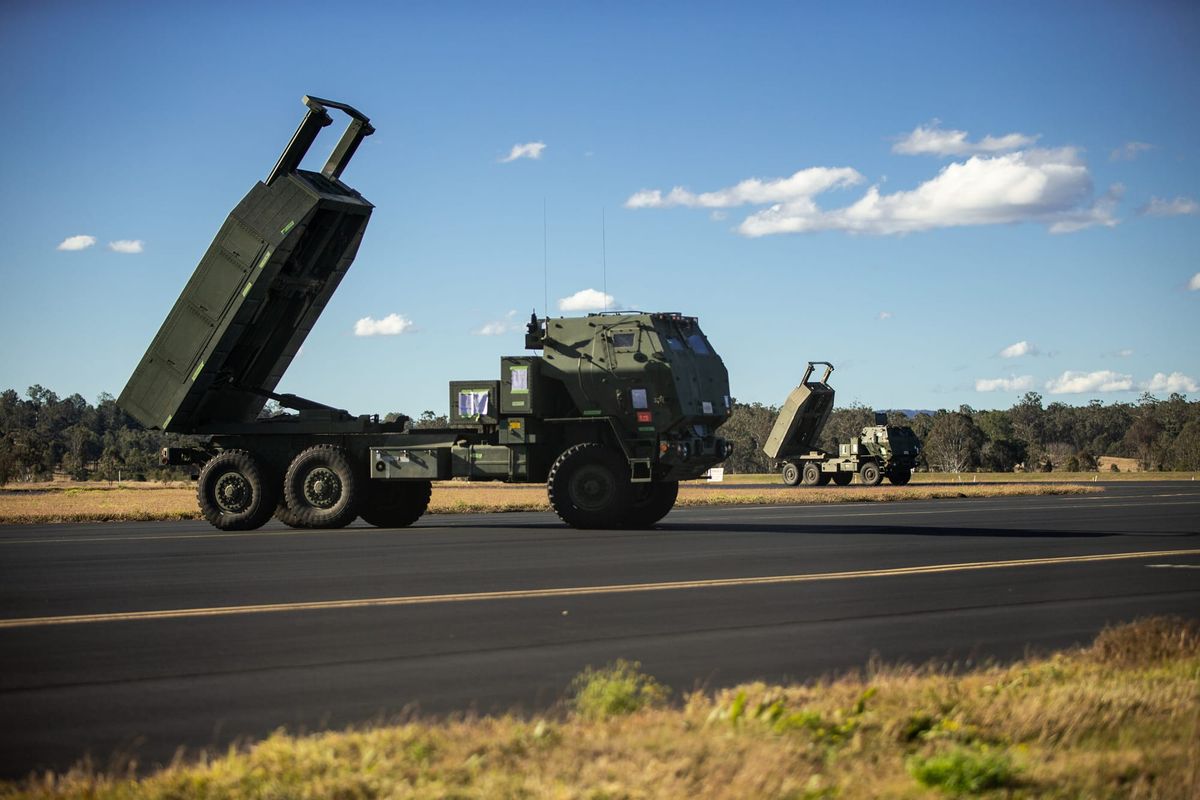
The Australian Army has deployed and fired its High Mobility Artillery Rocket System (HIMARS) overseas for the first time, marking a milestone in its efforts to develop a rapidly deployable long-range strike capability across the Indo-Pacific.
Two HIMARS launchers from the 14th Regiment, Royal Australian Artillery, were transported from Darwin to Indonesia aboard a Royal Australian Air Force C-130J Hercules during Exercise Keris Woomera, which concluded on 20 October.
The deployment involved two stages. The launchers were initially flown to Banyuwangi Airport in East Java before being moved to Sam Ratulangi International Airport in Manado, North Sulawesi.
Although the Army had previously transported HIMARS aboard Hercules aircraft within Australia, this was its first overseas deployment of the system. Defence subsequently confirmed that Australian HIMARS had also conducted their first overseas live-fire activity during the exercise.
The operation tested more than the launchers' ability to fire rockets. It demonstrated the logistics, airlift coordination and security arrangements required to move a heavy precision-strike system between locations in a neighbouring country.
Each HIMARS launcher weighs more than 16 tonnes when combat loaded, placing substantial demands on the C-130J's cargo capacity.
Lieutenant Darcy Salmon, a troop commander with the 14th Regiment, said the exercise would help the Army understand how to move the system internationally and prepare for future operational requirements.
Australia and Indonesia expand military integration
Exercise Keris Woomera was the Australian Defence Force's largest overseas training activity of 2026, involving approximately 1,000 Australian personnel and more than 1,200 members of the Indonesian National Armed Forces.
The nine-day exercise, conducted in East Java, the Bali Sea and surrounding maritime areas, brought together land, maritime, air and cyber capabilities.
Alongside the first overseas deployment and firing of HIMARS, Defence reported two additional milestones: the first deployment of a RAAF No. 4 Squadron aircraft into Southeast Asia since the Second World War, and Australia's first cyber integration training with Indonesia.
Australian forces included HMAS Choules, HMAS Perth and HMAS Stalwart, supported by embarked MH-60R Seahawk helicopters, M777 howitzers, PC-21 aircraft and C-130J transports.
Indonesian forces contributed naval, artillery and aviation assets, including multiple-launch rocket systems and Super Tucano aircraft.
The combined training included amphibious landings, joint artillery engagements, maritime manoeuvres and air support operations.
Why the HIMARS deployment matters
For Australia, the importance of the exercise lies partly in where it took place.
Deploying HIMARS to Indonesia, repositioning the launchers by air and firing them alongside Indonesian forces demonstrated a degree of military cooperation that extends beyond routine exchanges and exercises.
It also offered a practical test of a central assumption behind Australia's expanding long-range strike capability: that mobile missile launchers can be moved from bases in Australia to operationally useful locations across the region.
Such mobility matters because the effectiveness of a ground-based missile system depends not only on its range, but also on whether it can reach suitable firing positions, receive targeting information and remain supplied and protected.
The Indonesian exercise addressed some of those challenges, particularly strategic airlift, movement coordination and cooperation with a regional partner.
Australia expands its long-range strike forces
The milestone comes as Australia accelerates its investment in HIMARS and the missiles it can launch.
On 7 October, the government announced that the Army had received its second tranche of HIMARS launchers from the United States, two years ahead of schedule.
The government plans to field up to 90 launchers across two long-range fires regiments within the Army's 10th Fires Brigade.
HIMARS can fire Guided Multiple Launch Rocket System (GMLRS) munitions as well as longer-range Precision Strike Missiles (PrSM).
According to the government, the introduction of PrSM will provide the ADF with the ability to engage targets at ranges of up to 500 kilometres, increasing to more than 1,000 kilometres with future missile increments.
The expanding force is intended to give the Army greater reach and flexibility across Australia's northern approaches and the wider Indo-Pacific.
The government has also begun developing domestic guided-missile production to support the growing capability, including Australian manufacture of GMLRS munitions and planned cooperation on PrSM production.
Comments ()